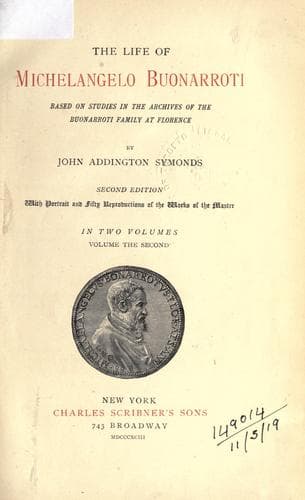
The Life of Michelangelo BuonarrotiSymonds, John Addington
History
The Life of Michelangelo Buonarroti
Symonds, John Addington
Michelangelo Buonarroti, 1475-1564
Two important letters from Michelangelo to Fattucci, written in
October 1525 and April 1526, show that he had then abandoned the
original scheme, and adopted one which was all but carried into
effect. "I am working as hard as I can, and in fifteen days I shall
begin the other captain. Afterwards the only important things left
will be the four rivers. The four statues on the sarcophagi, the four
figures on the ground which are the rivers, the two captains, and Our
Lady, who is to be placed upon the tomb at the head of the chapel;
these are what I mean to do with my own hand. Of these I have begun
six; and I have good hope of finishing them in due time, and carrying
the others forward in part, which do not signify so much." The six he
had begun are clearly the Dukes and their attendant figures of Day,
Night, Dawn, Evening. The Madonna, one of his noblest works, came
within a short distance of completion. SS. Cosimo and Damiano passed
into the hands of Montelupo and Montorsoli. Of the four rivers we have
only fragments in the shape of some exquisite little models. Where
they could have been conveniently placed is difficult to imagine;
possibly they were abandoned from a feeling that the chapel would be
overcrowded.
V
According to the plan adopted in this book, I shall postpone such
observations as I have to make upon the Medicean monuments until the
date when Michelangelo laid down his chisel, and shall now proceed
with the events of his life during the years 1525 and 1526.
He continued to be greatly troubled about the tomb of Julius II. The
lawsuit instituted by the Duke of Urbino hung over his head; and
though he felt sure of the Pope's powerful support, it was extremely
important, both for his character and comfort, that affairs should be
placed upon a satisfactory basis. Fattucci in Rome acted not only as
Clement's agent in business connected with S. Lorenzo; he also was
intrusted with negotiations for the settlement of the Duke's claims.
The correspondence which passed between them forms, therefore, our
best source of information for this period. On Christmas Eve in 1524
Michelangelo writes from Florence to his friend, begging him not to
postpone a journey he had in view, if the only business which detained
him was the trouble about the tomb. A pleasant air of manly affection
breathes through this document, showing Michelangelo to have been
unselfish in a matter which weighed heavily and daily on his spirits.
How greatly he was affected can be inferred from a letter written to
Giovanni Spina on the 19th of April 1525. While reading this, it must
be remembered that the Duke laid his action for the recovery of a
considerable balance, which he alleged to be due to him upon
disbursements made for the monument. Michelangelo, on the contrary,
asserted that he was out of pocket, as we gather from the lengthy
report he forwarded in 1524 to Fattucci. The difficulty in the
accounts seems to have arisen from the fact that payments for the
Public-domain text, read in full here on John Shaqi.
Reviews
Reviews
No reviews yet
Be the first to share your thoughts on this work.
Elsewhere in the archive
Join the Discussion
Join the discussion
Sign in to leave a comment or review.
Sign InorCreate an account