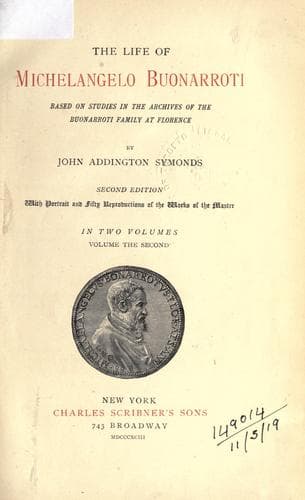
The Life of Michelangelo BuonarrotiSymonds, John Addington
History
The Life of Michelangelo Buonarroti
Symonds, John Addington
Michelangelo Buonarroti, 1475-1564
Florence surrendered in the month of August 1530. The terms were drawn
up by Don Ferrante Gonzaga, who commanded the Imperial forces after
the death of Filiberto, Prince of Orange, in concert with the Pope's
commissary-general, Baccio Valori. Malatesta Baglioni, albeit he went
about muttering that Florence "was no stable for mules" (alluding to
the fact that all the Medici were bastards), approved of the articles,
and showed by his conduct that he had long been plotting treason. The
act of capitulation was completed on the 12th, and accepted
unwillingly by the Signory. Valori, supported by Baglioni's military
force, reigned supreme in the city, and prepared to reinstate the
exiled family of princes. It said that Marco Dandolo of Venice, when
news reached the Pregadi of the fall of Florence, exclaimed aloud:
"Baglioni has put upon his head the cap of the biggest traitor upon
record."
V
The city was saved from wreckage by a lucky quarrel between the
Italian and Spanish troops in the Imperial camp. But no sooner was
Clement aware that Florence lay at his mercy, than he disregarded the
articles of capitulation, and began to act as an autocratic despot.
Before confiding the government to his kinsmen, the Cardinal Ippolito
and Alessandro Duke of Penna, he made Valori institute a series of
criminal prosecutions against the patriots. Battista della Palla and
Raffaello Girolami were sent to prison and poisoned. Five citizens
were tortured and decapitated in one day of October. Those who had
managed to escape from Florence were sentenced to exile, outlawry, and
confiscation of goods by hundreds. Charles V. had finally to interfere
and put a stop to the fury of the Pope's revenges. How cruel and
exasperated the mind of Clement was, may be gathered from his
treatment of Fra Benedetto da Foiano, who sustained the spirit of the
burghers by his fiery preaching during the privations of the siege.
Foiano fell into the clutches of Malatesta Baglioni, who immediately
sent him down to Rome. By the Pope's orders the wretched friar was
flung into the worst dungeon in the Castle of S. Angelo, and there
slowly starved to death by gradual diminution of his daily dole of
bread and water. Readers of Benvenuto Cellini's Memoirs will remember
the horror with which he speaks of this dungeon and of its dreadful
reminiscences, when it fell to his lot to be imprisoned there.
Public-domain text, read in full here on John Shaqi.
Reviews
Reviews
No reviews yet
Be the first to share your thoughts on this work.
Elsewhere in the archive
Join the Discussion
Join the discussion
Sign in to leave a comment or review.
Sign InorCreate an account