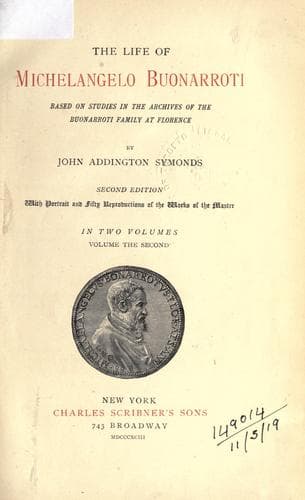
The Life of Michelangelo BuonarrotiSymonds, John Addington
History
The Life of Michelangelo Buonarroti
Symonds, John Addington
Michelangelo Buonarroti, 1475-1564
Such being the mood of Clement, it is not wonderful that Michelangelo
should have trembled for his own life and liberty. As Varchi says, "He
had been a member of the Nine, had fortified the hill and armed the
bell-tower of S. Miniato. What was more annoying, he was accused,
though falsely, of proposing to raze the palace of the Medici, where
in his boyhood Lorenzo and Piero de' Medici had shown him honour as a
guest at their own tables, and to name the space on which it stood the
Place of Mules." For this reason he hid himself, as Condivi and Varchi
assert, in the house of a trusty friend. The Senator Filippo
Buonarroti, who diligently collected traditions about his illustrious
ancestor, believed that his real place of retreat was the bell-tower
of S. Nicolò, beyond the Arno. "When Clement's fury abated," says
Condivi, "he wrote to Florence ordering that search should be made for
Michelangelo, and adding that when he was found, if he agreed to go on
working at the Medicean monuments, he should be left at liberty and
treated with due courtesy. On hearing news of this, Michelangelo came
forth from his hiding-place, and resumed the statues in the sacristy
of S. Lorenzo, moved thereto more by fear of the Pope than by love for
the Medici." From correspondence carried on between Rome and Florence
during November and December, we learn that his former pension of
fifty crowns a month was renewed, and that Giovan Battista Figiovanni,
a Prior of S. Lorenzo, was appointed the Pope's agent and paymaster.
An incident of some interest in the art-history of Florence is
connected with this return of the Medici, and probably also with
Clement's desire to concentrate Michelangelo's energies upon the
sacristy. So far back as May 10, 1508, Piero Soderini wrote to the
Marquis of Massa-Carrara, begging him to retain a large block of
marble until Michelangelo could come in person and superintend its
rough-hewing for a colossal statue to be placed on the Piazza. After
the death of Leo, the stone was assigned to Baccio Bandinelli; but
Michelangelo, being in favour with the Government at the time of the
expulsion of the Medici, obtained the grant of it. His first
intention, in which Bandinelli followed him, was to execute a Hercules
trampling upon Cacus, which should stand as pendant to his own David.
Public-domain text, read in full here on John Shaqi.
Reviews
Reviews
No reviews yet
Be the first to share your thoughts on this work.
Elsewhere in the archive
Join the Discussion
Join the discussion
Sign in to leave a comment or review.
Sign InorCreate an account