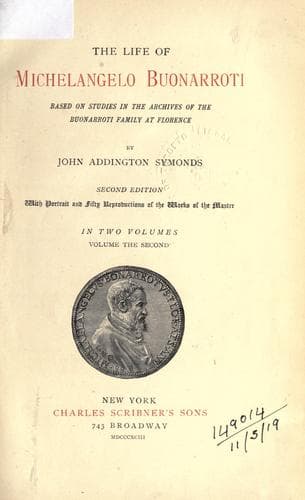
The Life of Michelangelo BuonarrotiSymonds, John Addington
History
The Life of Michelangelo Buonarroti
Symonds, John Addington
Michelangelo Buonarroti, 1475-1564
By a deliberation of the Signory, under date August 22, 1528, we are
informed that the marble had been brought to Florence about three
years earlier, and that Michelangelo now received instructions,
couched in the highest terms of compliment, to proceed with a group of
two figures until its accomplishment. If Vasari can be trusted,
Michelangelo made numerous designs and models for the Cacus, but
afterwards changed his mind, and thought that he would extract from
the block a Samson triumphing over two prostrate Philistines. The
evidence for this change of plan is not absolutely conclusive. The
deliberation of August 22, 1528, indeed left it open to his discretion
whether he should execute a Hercules and Cacus, or any other group of
two figures; and the English nation at South Kensington possesses one
of his noble little wax models for a Hercules. We may perhaps,
therefore, assume that while Bandinelli adhered to the Hercules and
Cacus, Michelangelo finally decided on a Samson. At any rate, the
block was restored in 1530 to Bandinelli, who produced the misbegotten
group which still deforms the Florentine Piazza.
Michelangelo had some reason to be jealous of Bandinelli, who
exercised considerable influence at the Medicean court, and was an
unscrupulous enemy both in word and deed. A man more widely and worse
hated than Bandinelli never lived. If any piece of mischief happened
which could be fixed upon him with the least plausibility, he bore the
blame. Accordingly, when Buonarroti's workshop happened to be broken
open, people said that Bandinelli was the culprit. Antonio Mini left
the following record of the event: "Three months before the siege,
Michelangelo's studio in Via Mozza was burst into with chisels, about
fifty drawings of figures were stolen, and among them the designs for
the Medicean tombs, with others of great value; also four models in
wax and clay. The young men who did it left by accident a chisel
marked with the letter M., which led to their discovery. When they
knew they were detected, they made off or hid themselves, and sent to
say they would return the stolen articles, and begged for pardon." Now
the chisel branded with an M. was traced to Michelangelo, the father
of Baccio Bandinelli, and no one doubted that he was the burglar.
Public-domain text, read in full here on John Shaqi.
Reviews
Reviews
No reviews yet
Be the first to share your thoughts on this work.
Elsewhere in the archive
Join the Discussion
Join the discussion
Sign in to leave a comment or review.
Sign InorCreate an account