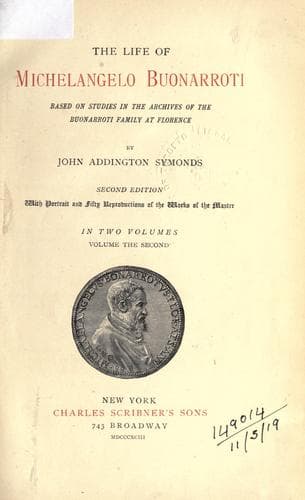
The Life of Michelangelo BuonarrotiSymonds, John Addington
History
The Life of Michelangelo Buonarroti
Symonds, John Addington
Michelangelo Buonarroti, 1475-1564
Staccoli, now appears for the first time upon the stage. It was
through his negotiations that the former contracts for the tomb of
Julius were finally annulled and a new design adopted. Michelangelo
offered, with the view of terminating all disputes, to complete the
monument on a reduced scale at his own cost, and furthermore to
disburse the sum of 2000 ducats in discharge of any claims the Della
Rovere might have against him. This seemed too liberal, and when
Clement was informed of the project, he promised to make better terms.
Indeed, during the course of these negotiations the Pope displayed the
greatest interest in Michelangelo's affairs. Staccoli, on the Duke's
part, raised objections; and Sebastiano had to remind him that, unless
some concessions were made, the scheme of the tomb might fall through:
"for it does not rain Michelangelos, and men could hardly be found to
preserve the work, far less to finish it." In course of time the
Duke's ambassador at Rome, Giovan Maria della Porta, intervened, and
throughout the whole business Clement was consulted upon every detail.
Sebastiano kept up his correspondence through the summer of 1531.
Meanwhile the suspense and anxiety were telling seriously on
Michelangelo's health. Already in June news must have reached Rome
that his health was breaking down; for Clement sent word recommending
him to work less, and to relax his spirits by exercise. Toward the
autumn he became alarmingly ill. We have a letter from Paolo Mini, the
uncle of his servant Antonio, written to Baccio Valori on the 29th of
September. After describing the beauty of two statues for the Medicean
tombs, Mini says he fears that "Michelangelo will not live long,
unless some measures are taken for his benefit. He works very hard,
eats little and poorly, and sleeps less. In fact, he is afflicted with
two kinds of disorder, the one in his head, the other in his heart.
Neither is incurable, since he has a robust constitution; but for the
good of his head, he ought to be restrained by our Lord the Pope from
working through the winter in the sacristy, the air of which is bad
for him; and for his heart, the best remedy would be if his Holiness
could accommodate matters with the Duke of Urbino." In a second
letter, of October 8, Mini insists again upon the necessity of freeing
Michelangelo's mind from his anxieties. The upshot was that Clement,
on the 21st of November, addressed a brief to his sculptor, whereby
Buonarroti was ordered, under pain of excommunication, to lay aside
all work except what was strictly necessary for the Medicean
monuments, and to take better care of his health. On the 26th of the
same month Benvenuto della Volpaia wrote, repeating what the Pope had
written in his brief, and adding that his Holiness desired him to
select some workshop more convenient for his health than the cold and
cheerless sacristy.
Public-domain text, read in full here on John Shaqi.
Reviews
Reviews
No reviews yet
Be the first to share your thoughts on this work.
Elsewhere in the archive
Join the Discussion
Join the discussion
Sign in to leave a comment or review.
Sign InorCreate an account