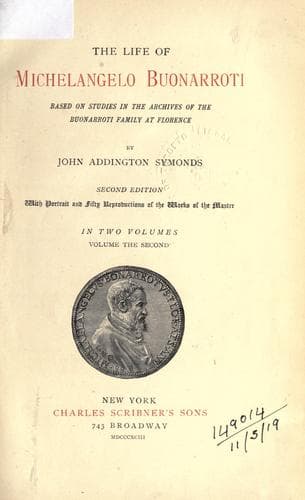
The Life of Michelangelo BuonarrotiSymonds, John Addington
History
The Life of Michelangelo Buonarroti
Symonds, John Addington
Michelangelo Buonarroti, 1475-1564
In spite of Clement's orders that Michelangelo should confine himself
strictly to working on the Medicean monuments, he continued to be
solicited with various commissions. Thus the Cardinal Cybo wrote in
December begging him to furnish a design for a tomb which he intended
to erect. Whether Michelangelo consented is not known.
Early in December Sebastiano resumed his communications on the subject
of the tomb of Julius, saying that Michelangelo must not expect to
satisfy the Duke without executing the work, in part at least,
himself. "There is no one but yourself that harms you: I mean, your
eminent fame and the greatness of your works. I do not say this to
flatter you. Therefore, I am of opinion that, without some shadow of
yourself, we shall never induce those parties to do what we want. It
seems to me that you might easily make designs and models, and
afterwards assign the completion to any master whom you choose. But
the shadow of yourself there must be. If you take the matter in this
way, it will be a trifle; you will do nothing, and seem to do all; but
remember that the work must be carried out under your shadow." A
series of despatches, forwarded between December 4, 1531, and April
29, 1532, by Giovan Maria della Porta to the Duke of Urbino, confirm
the particulars furnished by the letters which Sebastiano still
continued to write from Rome. At the end of 1531 Michelangelo
expressed his anxiety to visit Rome, now that the negotiations with
the Duke were nearly complete. Sebastiano, hearing this, replies: "You
will effect more in half an hour than I can do in a whole year. I
believe that you will arrange everything after two words with his
Holiness; for our Lord is anxious to meet your wishes." He wanted to
be present at the drawing up and signing of the contract. Clement,
however, although he told Sebastiano that he should be glad to see
him, hesitated to send the necessary permission, and it was not until
the month of April 1532 that he set out. About the 6th, as appears
from the indorsement of a letter received in his absence, he must have
reached Rome. The new contract was not ready for signature before the
29th, and on that date Michelangelo left for Florence, having, as he
says, been sent off by the Pope in a hurry on the very day appointed
for its execution. In his absence it was duly signed and witnessed
before Clement; the Cardinals Gonzaga and da Monte and the Lady Felice
della Rovere attesting, while Giovan Maria della Porta and Girolamo
Staccoli acted for the Duke of Urbino. When Michelangelo returned and
saw the instrument, he found that several clauses prejudicial to his
interests had been inserted by the notary. "I discovered more than
1000 ducats charged unjustly to my debit, also the house in which I
live, and certain other hooks and crooks to ruin me. The Pope would
certainly not have tolerated this knavery, as Fra Sebastiano can bear
witness, since he wished me to complain to Clement and have the notary
hanged.
Public-domain text, read in full here on John Shaqi.
Reviews
Reviews
No reviews yet
Be the first to share your thoughts on this work.
Elsewhere in the archive
Join the Discussion
Join the discussion
Sign in to leave a comment or review.
Sign InorCreate an account