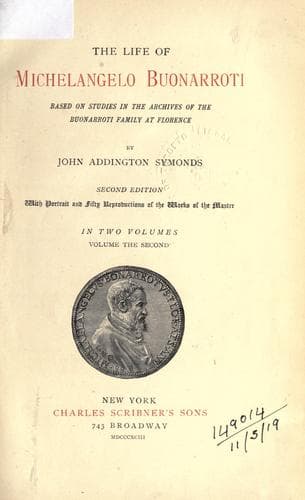
The Life of Michelangelo BuonarrotiSymonds, John Addington
History
The Life of Michelangelo Buonarroti
Symonds, John Addington
Michelangelo Buonarroti, 1475-1564
Two exits from the false situation existed: one was the
picturesqueness of the Barocco style; the other was the specious vapid
purity of the Palladian. Michelangelo, who was essentially the genius
of this transition, can neither be ascribed to the Barocco architects,
although he called them into being, nor yet can he be said to have
arrived at the Palladian solution. He held both types within himself
in embryo, arriving at a moment of profound and complicated difficulty
for the practical architect; without technical education, but gifted
with supreme genius, bringing the imperious instincts of a sublime
creative amateur into every task appointed him. We need not wonder if
a man of his calibre left the powerful impress of his personality upon
an art in chaos, luring lesser craftsmen into the Barocco mannerism,
while he provoked reaction in the stronger, who felt more
scientifically what was needed to secure firm standing-ground. Bernini
and the superb fountain of Trevi derive from Michelangelo on one side;
Vignola's cold classic profiles and Palladio's resuscitation of old
Rome in the Palazzo della Ragione at Vicenza emerge upon the other. It
remained Buonarroti's greatest-glory that, lessoned by experience and
inspired for high creation by the vastness of the undertaking, he
imagined a world's wonder in the cupola of S. Peter's.
III
Writing in the mid-stream of this architectural regurgitation, Vasari
explains what contemporaries thought about Michelangelo's innovations.
"He wished to build the new sacristy upon the same lines as the older
one by Brunelleschi, but at the same time to clothe the edifice with a
different style of decoration. Accordingly, he invented for the
interior a composite adornment, of the newest and most varied manner
which antique and modern masters joined together could have used. The
novelty of his style consisted in those lovely cornices, capitals,
basements, doors, niches, and sepulchres which transcended all that
earlier builders, working by measurements, distribution of parts, and
rule, had previously effected, following Vitruvius and the ancient
relics. Such men were afraid to supplement tradition with original
invention. The license he introduced gave great courage to those who
studied his method, and emboldened them to follow on his path. Since
that time, new freaks of fancy have been seen, resembling the style of
arabesque and grotesque more than was consistent with tradition. For
this emancipation of the art, all craftsmen owe him an infinite and
everduring debt of gratitude, since he at one blow broke down the
bands and chains which barred the path they trod in common."
Public-domain text, read in full here on John Shaqi.
Reviews
Reviews
No reviews yet
Be the first to share your thoughts on this work.
Elsewhere in the archive
Join the Discussion
Join the discussion
Sign in to leave a comment or review.
Sign InorCreate an account