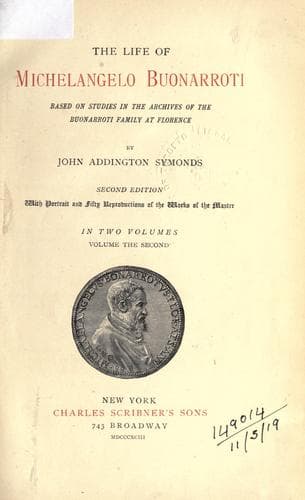
The Life of Michelangelo BuonarrotiSymonds, John Addington
History
The Life of Michelangelo Buonarroti
Symonds, John Addington
Michelangelo Buonarroti, 1475-1564
If I am right in thus interpreting an unusually incoherent passage of
Vasari's criticism, no words could express more clearly the advent of
Barocco mannerism. But Vasari proceeds to explain his meaning with
still greater precision. Afterwards he made a plainer demonstration
of his intention in the library of S. Lorenzo, by the splendid
distribution of the windows, the arrangement of the upper chamber, and
the marvellous entrance-hall into that enclosed building.
"The grace and charm of art were never seen more perfectly displayed
in the whole and in the parts of any edifice than here. I may refer in
particular to the corbels, the recesses for statues, and the cornices.
The staircase, too, deserves attention for its convenience, with the
eccentric breakage of its flights of steps; the whole construction
being so altered from the common usage of other architects as to
excite astonishment in all who see it."
What emerges with distinctness from Vasari's account of Michelangelo's
work at S. Lorenzo is that a practical Italian architect, who had been
engaged on buildings of importance since this work was carried out,
believed it to have infused freedom and new vigour into architecture.
That freedom and new vigour we now know to have implied the Barocco
style.
IV
In estimating Michelangelo's work at S. Lorenzo, we must not forget
that at this period of his life he contemplated statuary, bronze
bas-relief, and painting, as essential adjuncts to architecture. The
scheme is, therefore, not so much constructive as decorative, and a
great many of its most offensive qualities may be ascribed to the fact
that the purposes for which it was designed have been omitted. We know
that the façade of S. Lorenzo was intended to abound in bronze and
marble carvings. Beside the Medicean tombs, the sacristy ought to have
contained a vast amount of sculpture, and its dome was actually
painted in fresco by Giovanni da Udine under Michelangelo's own eyes.
It appears that his imagination still obeyed those leading principles
which he applied in the rough sketch for the first sepulchre of
Julius. The vestibule and staircase of the library cannot therefore be
judged fairly now; for if they had been finished according to their
maker's plan, the faults of their construction would have been
compensated by multitudes of plastic shapes.
Public-domain text, read in full here on John Shaqi.
Reviews
Reviews
No reviews yet
Be the first to share your thoughts on this work.
Elsewhere in the archive
Join the Discussion
Join the discussion
Sign in to leave a comment or review.
Sign InorCreate an account