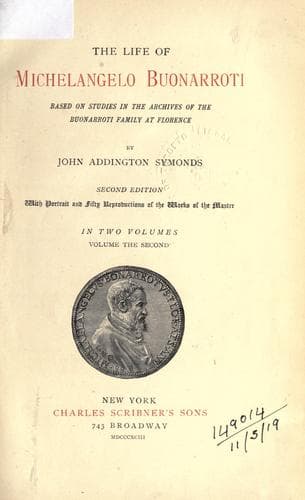
The Life of Michelangelo BuonarrotiSymonds, John Addington
History
The Life of Michelangelo Buonarroti
Symonds, John Addington
Michelangelo Buonarroti, 1475-1564
We have here no masterpiece of sound constructive science, but a freak
of inventive fancy using studied details for the production of a
pictorial effect. The details employed to compose this curious
illusion are painfully dry and sterile; partly owing to the scholastic
enthusiasm for Vitruvius, partly to the decline of mediaeval delight
in naturalistic decoration, but, what seems to me still more apparent,
through Michelangelo's own passionate preoccupation with the human
figure. He could not tolerate any type of art which did not concede a
predominant position to the form of man. Accordingly, his work in
architecture at this period seems waiting for plastic illustration,
demanding sculpture and fresco for its illumination and justification.
It is easy, one would think, to make an appeal to the eye by means of
colossal orders, bold cornices, enormous consoles, deeply indented
niches. How much more easy to construct a box, and then say, "Come,
let us cover its inside with an incongruous and inappropriate but
imposing parade of learning," than to lift some light and genial thing
of beauty aloft into the air, as did the modest builder of the
staircase to the hall at Christ Church, Oxford! The eye of the vulgar
is entranced, the eye of the artist bewildered. That the imagination
which inspired that decorative scheme was powerful, original, and
noble, will not be denied; but this does not save us from the
desolating conviction that the scheme itself is a specious and
pretentious mask, devised to hide a hideous waste of bricks and
mortar.
Michelangelo's imagination, displayed in this distressing piece of
work, was indeed so masterful that, as Vasari says, a new delightful
style in architecture seemed to be revealed by it. A new way of
clothing surfaces, falsifying façades, and dealing picturesquely with
the lifeless element of Vitruvian tradition had been demonstrated by
the genius of one who was a mighty amateur in building. In other
words, the _Barocco_ manner had begun; the path was opened to prank,
caprice, and license. It required the finer tact and taste of a
Palladio to rectify the false line here initiated, and to bring the
world back to a sense of seriousness in its effort to deal
constructively and rationally with the pseudo-classic mannerism.
Public-domain text, read in full here on John Shaqi.
Reviews
Reviews
No reviews yet
Be the first to share your thoughts on this work.
Elsewhere in the archive
Join the Discussion
Join the discussion
Sign in to leave a comment or review.
Sign InorCreate an account