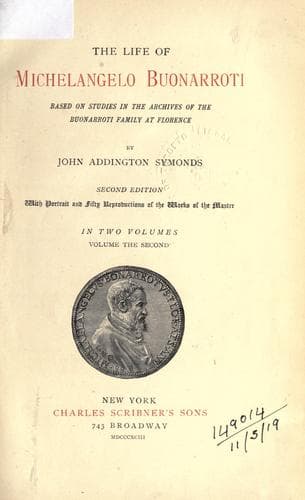
The Life of Michelangelo BuonarrotiSymonds, John Addington
History
The Life of Michelangelo Buonarroti
Symonds, John Addington
Michelangelo Buonarroti, 1475-1564
Michelangelo arrived at the moment I am attempting to indicate. He
protested that architecture was not his trade. Over and over again he
repeated this to his Medicean patrons; but they compelled him to
build, and he applied himself with the predilections and
prepossessions of a plastic artist to the task. The result was a
retrogression from the point reached by his immediate predecessors to
the vicious system followed by the pseudo-Gothic architects in Italy.
That is to say, he treated the structure as an inert mass, to be made
as substantial as possible, and then to be covered with details
agreeable to the eye. At the beginning of his career he had a
defective sense of the harmonic ratios upon which a really musical
building may be constructed out of mere bricks and mortar--such, for
example, as the Church of S. Giustina at Padua. He was overweighted
with ill-assimilated erudition; and all the less desirable licenses of
Brunelleschi's school, especially in the abuse of square recesses, he
adopted without hesitation. It never seems to have occurred to him
that doors which were intended for ingress and egress, windows which
were meant to give light, and attics which had a value as the means of
illumination from above, could not with any propriety be applied to
the covering of blank dead spaces in the interiors of buildings.
The vestibule of the Laurentian Library illustrates his method of
procedure. It is a rectangular box of about a cube and two thirds, set
length-way up. The outside of the building, left unfinished, exhibits
a mere blank space of bricks. The interior might be compared to a
temple in the grotesque-classic style turned outside in: colossal
orders, meaningless consoles, heavy windows, square recesses, numerous
doors--the windows, doors, and attics having no right to be there,
since they lead to nothing, lend view to nothing, clamour for bronze
and sculpture to explain their existence as niches and receptacles for
statuary. It is nevertheless indubitably true that these incongruous
and misplaced elements, crowded together, leave a strong impression of
picturesque force upon the mind. From certain points and angles, the
effect of the whole, considered as a piece of deception and
insincerity, is magnificent. It would be even finer than it is, were
not the Florentine _pietra serena_ of the stonework so repellent in
its ashen dulness, the plaster so white, and the false architectural
system so painfully defrauded of the plastic forms for which it was
intended to subserve as setting.
Public-domain text, read in full here on John Shaqi.
Reviews
Reviews
No reviews yet
Be the first to share your thoughts on this work.
Elsewhere in the archive
Join the Discussion
Join the discussion
Sign in to leave a comment or review.
Sign InorCreate an account