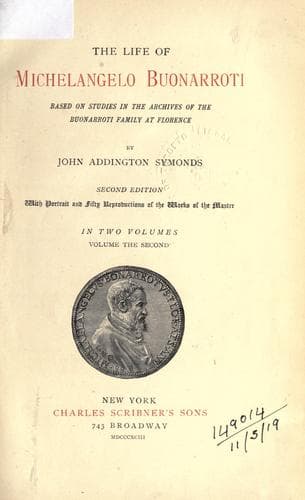
The Life of Michelangelo BuonarrotiSymonds, John Addington
History
The Life of Michelangelo Buonarroti
Symonds, John Addington
Michelangelo Buonarroti, 1475-1564
At this point it may not unprofitably be remarked, that none of the
problems offered for solution at S. Lorenzo were in the strictest
sense of that word architectural. The façade presented a problem of
pure panelling. The ground-plan of the sacristy was fixed in
correspondence with Brunelleschi's; and here again the problem
resolved itself chiefly into panelling. A builder of genius, working
on the library, might indeed have displayed his science and his taste
by some beautiful invention adapted to the awkward locality; as
Baldassare Peruzzi, in the Palazzo Massimo at Rome, converted the
defects of the site into graces by the exquisite turn he gave to the
curved portion of the edifice. Still, when the scheme was settled,
even the library became more a matter of panelling and internal
fittings than of structural design. Nowhere at S. Lorenzo can we
affirm that Michelangelo enjoyed, the opportunity of showing what he
could achieve in the production of a building independent in itself
and planned throughout with a free hand. Had he been a born architect,
he would probably have insisted upon constructing the Medicean
mausoleum after his own conception instead of repeating Brunelleschi's
ground-plan, and he would almost certainly have discovered a more
genial solution for the difficulties of the library. But he protested
firmly against being considered an architect by inclination or by
education. Therefore he accepted the most obvious conditions of each
task, and devoted himself to schemes of surface decoration.
Public-domain text, read in full here on John Shaqi.
Reviews
Reviews
No reviews yet
Be the first to share your thoughts on this work.
Elsewhere in the archive
Join the Discussion
Join the discussion
Sign in to leave a comment or review.
Sign InorCreate an account