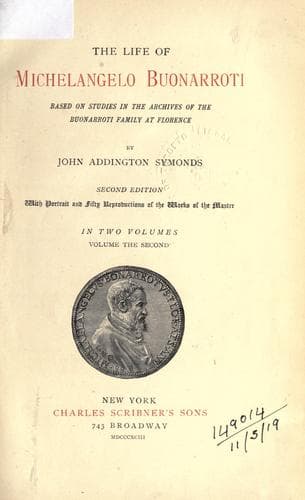
The Life of Michelangelo BuonarrotiSymonds, John Addington
History
The Life of Michelangelo Buonarroti
Symonds, John Addington
Michelangelo Buonarroti, 1475-1564
The interior of the sacristy is planned with a noble sense of unity.
For the purpose of illuminating a gallery of statues, the lighting may
be praised without reserve; and there is no doubt whatever that
Michelangelo intended every tabernacle to be filled with figures, and
all the whitewashed spaces of the walls to be encrusted with
bas-reliefs in stucco or painted in fresco. The recesses or niches,
taking the form of windows, are graduated in three degrees of depth to
suit three scales of sculptural importance. The sepulchres of the
Dukes had to emerge into prominence; the statues subordinate to these
main masses occupied shallower recesses; the shallowest of all,
reserved for minor statuary, are adorned above with garlands, which
suggest the flatness of the figures to be introduced. Architecturally
speaking, the building is complete; but it sadly wants the plastic
decoration for which it was designed, together with many finishing
touches of importance. It is clear, for instance, that the square
pedestals above the double pilasters flanking each of the two Dukes
were meant to carry statuettes or candelabra, which would have
connected the marble panelling with the cornices and stucchi and
frescoed semicircles of the upper region. Our eyes are everywhere
defrauded of the effect calculated by Michelangelo when he planned
this chapel. Yet the total impression remains harmonious. Proportion
has been observed in all the parts, especially in the relation of the
larger to the smaller orders, and in the balance of the doors and
windows. Merely decorative carvings are used with parsimony, and
designed in a pure style, although they exhibit originality of
invention. The alternation of white marble surfaces and mouldings with
_pietra serena_ pilasters, cornices, and arches, defines the
structural design, and gives a grave but agreeable sense of variety.
Finally, the recess behind the altar adds lightness and space to what
would otherwise have been a box. What I have already observed when
speaking of the vestibule to the library must be repeated here: the
whole scheme is that of an exterior turned outside in, and its
justification lies in the fact that it demanded statuary and colour
for its completion. Still the bold projecting cornices, the deeper and
shallower niches resembling windows, have the merit of securing broken
lights and shadows under the strong vertical illumination, all of
which are eminently picturesque. No doubt remains now that tradition
is accurate in identifying the helmeted Duke with Lorenzo de' Medici,
and the more graceful seated hero opposite with Giuliano. The
recumbent figures on the void sepulchres beneath them are with equal
truth designated as Night and Day, Morning and Evening. But
Michelangelo condescended to no realistic portraiture in the statues
of the Dukes, and he also meant undoubtedly to treat the phases of
time which rule man's daily life upon the planet as symbols for
Public-domain text, read in full here on John Shaqi.
Reviews
Reviews
No reviews yet
Be the first to share your thoughts on this work.
Elsewhere in the archive
Join the Discussion
Join the discussion
Sign in to leave a comment or review.
Sign InorCreate an account