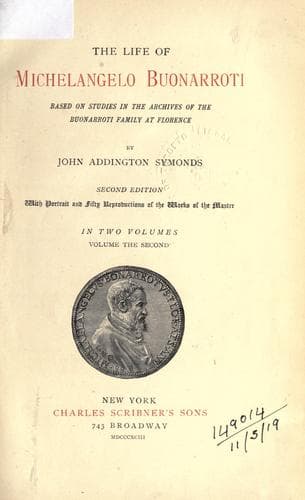
The Life of Michelangelo BuonarrotiSymonds, John Addington
History
The Life of Michelangelo Buonarroti
Symonds, John Addington
Michelangelo Buonarroti, 1475-1564
"The sacristy may be looked on either as the masterpiece of a sculptor
who required fit setting for his statues, or of an architect who
designed statues to enhance the structure he had planned. Both arts
are used with equal ease, nor has the genius of Michelangelo dealt
more masterfully with the human frame than with the forms of Roman
architecture in this chapel. He seems to have paid no heed to classic
precedent, and to have taken no pains to adapt the parts to the
structural purpose of the building. It was enough for him to create a
wholly novel framework for the modern miracle of sculpture it
enshrines, attending to such rules of composition as determine light
and shade, and seeking by the relief of mouldings and pilasters to
enhance the terrible and massive forms that brood above the Medicean
tombs. The result is a product of picturesque and plastic art as true
to the Michelangelesque spirit as the Temple of the Wingless Victory
to that of Pheidias. But where Michelangelo achieved a triumph of
boldness, lesser natures were betrayed into bizarrerie; and this
chapel of the Medici, in spite of its grandiose simplicity, proved a
stumbling-block to subsequent architects by encouraging them to
despise propriety and violate the laws of structure.
"We may assume then that the colossal statues of Giuliano and Lorenzo
were studied with a view to their light and shadow as much as to their
form; and this is a fact to be remembered by those who visit the
chapel where Buonarroti laboured both as architect and sculptor. Of
the two Medici, it is not fanciful to say that the Duke of Urbino is
the most immovable of spectral shapes eternalised in marble; while the
Duke of Nemours, more graceful and elegant, seems intended to present
a contrast to this terrible thought-burdened form. The allegorical
figures, stretched on segments of ellipses beneath the pedestals of
the two Dukes, indicate phases of darkness and of light, of death and
life. They are two women and two men; tradition names them Night and
Day, Twilight and Dawning. Thus in the statues themselves and in their
attendant genii we have a series of abstractions, symbolising the
sleep and waking of existence, action and thought, the gloom of death,
the lustre of life, and the intermediate states of sadness and of hope
that form the borderland of both. Life is a dream between two
slumbers; sleep is death's twin-brother; night is the shadow of death;
death is the gate of life:--such is the mysterious mythology wrought
by the sculptor of the modern world in marble. All these figures, by
the intensity of their expression, the vagueness of their symbolism,
force us to think and question. What, for example, occupies Lorenzo's
brain? Bending forward, leaning his chin upon his wrist, placing the
other hand upon his knee, on what does he for ever ponder?
Public-domain text, read in full here on John Shaqi.
Reviews
Reviews
No reviews yet
Be the first to share your thoughts on this work.
Elsewhere in the archive
Join the Discussion
Join the discussion
Sign in to leave a comment or review.
Sign InorCreate an account