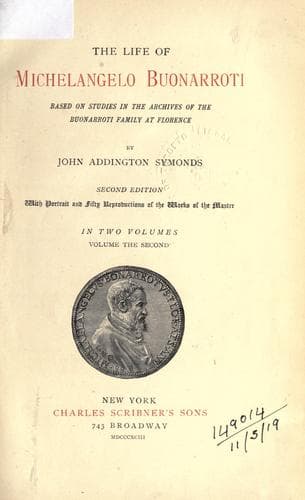
The Life of Michelangelo BuonarrotiSymonds, John Addington
History
The Life of Michelangelo Buonarroti
Symonds, John Addington
Michelangelo Buonarroti, 1475-1564
"The sight, as Rogers said well, 'fascinates and is intolerable.'
Michelangelo has shot the beaver of the helmet forward on his
forehead, and bowed his head, so as to clothe the face in darkness.
But behind the gloom there lurks no fleshless skull, as Rogers
fancied. The whole frame of the powerful man is instinct with some
imperious thought. Has he outlived his life and fallen upon
everlasting contemplation? Is he brooding, injured and indignant, over
his own doom and the extinction of his race? Is he condemned to
witness in immortal immobility the woes of Italy he helped to cause?
Or has the sculptor symbolised in him the burden of that personality
we carry with us in this life, and bear for ever when we wake into
another world? Beneath this incarnation of oppressive thought there
lie, full length and naked, the figures of Dawn and Twilight, Morn and
Evening. So at least they are commonly called, and these names are not
inappropriate; for the breaking of the day and the approach of night
are metaphors for many transient conditions of the soul. It is only as
allegories in a large sense, comprehending both the physical and
intellectual order, and capable of various interpretation, that any of
these statues can be understood. Even the Dukes do not pretend to be
portraits, and hence in part perhaps the uncertainty that has gathered
round them. Very tranquil and noble is Twilight: a giant in repose, he
meditates, leaning upon his elbow, looking down. But Dawn starts from
her couch, as though some painful summons had reached her, sunk in
dreamless sleep, and called her forth to suffer. Her waking to
consciousness is like that of one who has been drowned, and who finds
the return to life agony. Before her eyes, seen even through the mists
of slumber, are the ruin and the shame of Italy. Opposite lies Night,
so sorrowful, so utterly absorbed in darkness and the shade of death,
that to shake off that everlasting lethargy seems impossible. Yet she
is not dead. If we raise our voices, she too will stretch her limbs,
and, like her sister, shudder into sensibility with sighs. Only we
must not wake her; for he who fashioned her has told us that her sleep
of stone is great good fortune. Both of these women are large and
brawny, unlike the Fates of Pheidias, in their muscular maturity. The
burden of Michelangelo's thought was too tremendous to be borne by
virginal and graceful beings. He had to make women no less capable of
suffering, no less world-wearied, than his country.
Public-domain text, read in full here on John Shaqi.
Reviews
Reviews
No reviews yet
Be the first to share your thoughts on this work.
Elsewhere in the archive
Join the Discussion
Join the discussion
Sign in to leave a comment or review.
Sign InorCreate an account