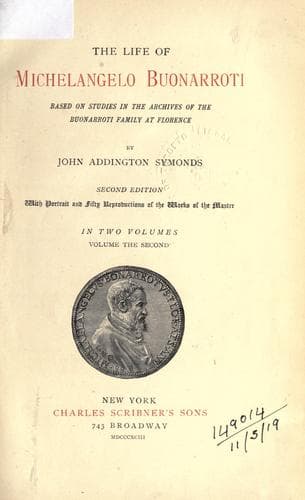
The Life of Michelangelo BuonarrotiSymonds, John Addington
History
The Life of Michelangelo Buonarroti
Symonds, John Addington
Michelangelo Buonarroti, 1475-1564
After the death of Clement VII., Michelangelo never returned to reside
for any length of time at Florence. The rest of his life was spent in
Rome, and he fell almost immediately under the kind but somewhat
arbitrary patronage of Alessandro Farnese, who succeeded to the Papal
chair in October 1534, with the title of Paul III.
One of the last acts of Clement's life had been to superintend the
second contract with the heirs of Julius, by which Michelangelo
undertook to finish the tomb upon a reduced scale within the space of
three years. He was allowed to come to Rome and work there during four
months annually. Paul, however, asserted his authority by upsetting
these arrangements and virtually cancelling the contract.
"In the meanwhile," writes Condivi, "Pope Clement died, and Paul III.
sent for him, and requested him to enter his service. Michelangelo saw
at once that he would be interrupted in his work upon the Tomb of
Julius. So he told Paul that he was not his own master, being bound to
the Duke of Urbino until the monument was finished. The Pope grew
angry, and exclaimed: 'It is thirty years that I have cherished this
desire, and now that I am Pope, may I not indulge it? Where is the
contract? I mean to tear it up.' Michelangelo, finding himself reduced
to these straits, almost resolved to leave Rome and take refuge in the
Genoese, at an abbey held by the Bishop of Aleria, who had been a
creature of Julius, and was much attached to him. He hoped that the
neighbourhood of the Carrara quarries, and the facility of
transporting marbles by sea, would help him to complete his
engagements. He also thought of settling at Urbino, which he had
previously selected as a tranquil retreat, and where he expected to be
well received for the sake of Pope Julius. Some months earlier, he
even sent a man of his to buy a house and land there. Still he dreaded
the greatness of the Pontiff, as indeed he had good cause to do; and
for this reason he abandoned the idea of quitting Rome, hoping to
pacify his Holiness with fair words.
Public-domain text, read in full here on John Shaqi.
Reviews
Reviews
No reviews yet
Be the first to share your thoughts on this work.
Elsewhere in the archive
Join the Discussion
Join the discussion
Sign in to leave a comment or review.
Sign InorCreate an account