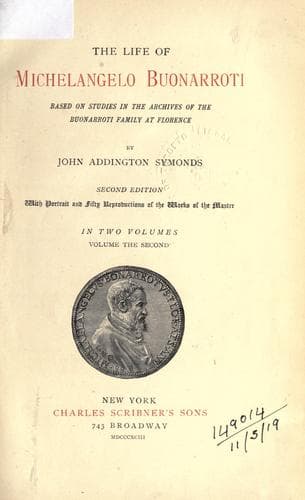
The Life of Michelangelo BuonarrotiSymonds, John Addington
History
The Life of Michelangelo Buonarroti
Symonds, John Addington
Michelangelo Buonarroti, 1475-1564
"Standing before these statues, we do not cry, How beautiful! We
murmur, How terrible, how grand! Yet, after long gazing, we find them
gifted with beauty beyond grace. In each of them there is a
palpitating thought, torn from the artist's soul and crystallised in
marble. It has been said that architecture is petrified music. In the
Sacristy of S. Lorenzo we feel impelled to remember phrases of
Beethoven. Each of these statues becomes for us a passion, fit for
musical expression, but turned like Niobe to stone. They have the
intellectual vagueness, the emotional certainty, that belong to the
motives of a symphony. In their allegories, left without a key,
sculpture has passed beyond her old domain of placid concrete form.
The anguish of intolerable emotion, the quickening of the
consciousness to a sense of suffering, the acceptance of the
inevitable, the strife of the soul with destiny, the burden and the
passion of mankind:--that is what they contain in their cold
chisel-tortured marble. It is open to critics of the school of Lessing
to object that here is the suicide of sculpture. It is easy to remark
that those strained postures and writhen limbs may have perverted the
taste of lesser craftsmen. Yet if Michelangelo was called to carve
Medicean statues after the sack of Rome and the fall of Florence--if
he was obliged in sober sadness to make sculpture a fit language for
his sorrow-laden heart--how could he have wrought more truthfully than
this? To imitate him without sharing his emotion or comprehending his
thoughts, as the soulless artists of the decadence attempted, was
without all doubt a grievous error. Surely also we may regret, not
without reason, that in the evil days upon which he had fallen, the
fair antique _Heiterkeit_ and _Allgemeinheit_ were beyond his reach."
That this regret is not wholly sentimental may be proved, I think, by
an exchange of verses, which we owe to Vasari's literary sagacity. He
tells us that when the statue of the Night was opened to the public
view, it drew forth the following quatrain from an author unknown to
himself by name:--
_The Night thou seest here, posed gracefully
In act of slumber, was by an Angel wrought
Out of this stone; sleeping, with life she's fraught:
Wake her, incredulous wight; she'll speak to thee._
Michelangelo would have none of these academical conceits and
compliments. He replied in four verses, which show well enough what
thoughts were in his brain when he composed the nightmare-burdened,
heavy-sleeping women:
_Dear is my sleep, but more to be mere stone,
So long as ruin and dishonour reign:
To hear naught, to feel naught, is my great gain;
Then wake me not; speak in an undertone._
CHAPTER XI
I
Public-domain text, read in full here on John Shaqi.
Reviews
Reviews
No reviews yet
Be the first to share your thoughts on this work.
Elsewhere in the archive
Join the Discussion
Join the discussion
Sign in to leave a comment or review.
Sign InorCreate an account