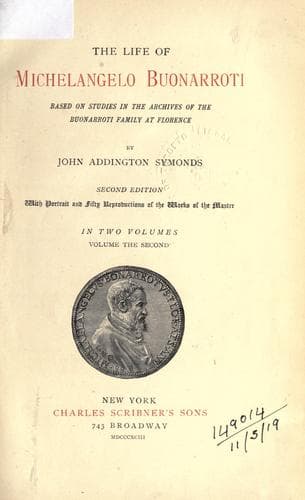
The Life of Michelangelo BuonarrotiSymonds, John Addington
History
The Life of Michelangelo Buonarroti
Symonds, John Addington
Michelangelo Buonarroti, 1475-1564
When Michelangelo began to work again in the Sistine Chapel, the wall
above the altar was adorned with three great sacred subjects by the
hand of Pietro Perugino. In the central fresco of the Assumption
Perugino introduced a portrait of Sixtus IV. kneeling in adoration
before the ascending Madonna. The side panels were devoted to the
Nativity and the finding of Moses. In what condition Michelangelo
found these frescoes before the painting of the Last Judgment we do
not know. Vasari says that he caused the wall to be rebuilt with
well-baked carefully selected bricks, and sloped inwards so that the
top projected half a cubit from the bottom. This was intended to
secure the picture from dust. Vasari also relates that Sebastiano del
Piombo, acting on his own responsibility, prepared this wall with a
ground for oil-colours, hoping to be employed by Michelangelo, but
that the latter had it removed, preferring the orthodox method of
fresco-painting. The story, as it stands, is not very probable; yet we
may perhaps conjecture that, before deciding on the system to be
adopted for his great work, Buonarroti thought fit to make experiments
in several surfaces. The painters of that period, as is proved by
Sebastiano's practice, by Lionardo da Vinci's unfortunate innovations
at Florence, and by the experiments of Raffaello's pupils in the hall
of Constantine, not unfrequently invented methods for mural decoration
which should afford the glow and richness of oil-colouring.
Michelangelo may even have proposed at one time to intrust a large
portion of his fresco to Sebastiano's executive skill, and afterwards
have found the same difficulties in collaboration which reduced him to
the necessity of painting the Sistine vault in solitude.
Be that as it may, when the doors of the chapel once closed behind the
master, we hear nothing whatsoever about his doings till they opened
again on Christmas Day in 1541. The reticence of Michelangelo
regarding his own works is one of the most trying things about him. It
is true indeed that his correspondence between 1534 and 1541 almost
entirely fails; still, had it been abundant, we should probably have
possessed but dry and laconic references to matters connected with the
business of his art.
Public-domain text, read in full here on John Shaqi.
Reviews
Reviews
No reviews yet
Be the first to share your thoughts on this work.
Elsewhere in the archive
Join the Discussion
Join the discussion
Sign in to leave a comment or review.
Sign InorCreate an account