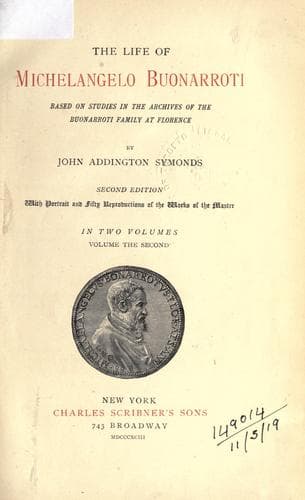
The Life of Michelangelo BuonarrotiSymonds, John Addington
History
The Life of Michelangelo Buonarroti
Symonds, John Addington
Michelangelo Buonarroti, 1475-1564
He must have been fully occupied on the Last Judgment during 1536 and
1537. Paul III. was still in correspondence with the Duke of Urbino,
who showed himself not only willing to meet the Pope's wishes with
regard to the Tomb of Julius, but also very well disposed toward the
sculptor. In July 1537, Hieronimo Staccoli wrote to the Duke of
Camerino about a silver salt-cellar which Michelangelo had designed at
his request. This prince, Guidobaldo della Rovere, when he afterwards
succeeded to the Duchy of Urbino, sent a really warm-hearted despatch
to his "dearest Messer Michelangelo." He begins by saying that, though
he still cherishes the strongest wish to see the monument of his uncle
completed, he does not like to interrupt the fresco in the Sistine
Chapel, upon which his Holiness has set his heart. He thoroughly
trusts in Michelangelo's loyalty, and is assured that his desire to
finish the tomb, for the honour of his former patron's memory, is keen
and sincere. Therefore, he hopes that when the picture of the Last
Judgment is terminated, the work will be resumed and carried to a
prosperous conclusion. In the meantime, let Buonarroti attend to his
health, and not put everything again to peril by overstraining his
energies.
Signer Gotti quotes a Papal brief, issued on the 18th of September
1537, in which the history of the Tomb of Julius up to date is set
forth, and Michelangelo's obligations toward the princes of Urbino are
recited. It then proceeds to declare that Clement VII. ordered him to
paint the great wall of the Sistine, and that Paul desires this work
to be carried forward with all possible despatch. He therefore lets it
be publicly known that Michelangelo has not failed to perform his
engagements in the matter of the tomb through any fault or action of
his own, but by the express command of his Holiness. Finally, he
discharges him and his heirs from all liabilities, pecuniary or other,
to which he may appear exposed by the unfulfilled contracts.
III
While thus engaged upon his fresco, Michelangelo received a letter,
dated Venice, September 15, 1537, from that rogue of genius, Pietro
Aretino. It opens in the strain of hyperbolical compliment and florid
rhetoric which Aretino affected when he chose to flatter. The man,
however, was an admirable stylist, the inventor of a new epistolary
manner. Like a volcano, his mind blazed with wit, and buried sound
sense beneath the scoriae and ashes it belched forth. Gifted with a
natural feeling for rhetorical contrast, he knew the effect of some
simple and impressive sentence, placed like a gem of value in the
midst of gimcrack conceits. Thus: "I should not venture to address
you, had not my name, accepted by the ears of every prince in Europe,
outworn much of its native indignity. And it is but meet that that I
should approach you with this reverence; for the world has many kings,
and one only Michelangelo.
Public-domain text, read in full here on John Shaqi.
Reviews
Reviews
No reviews yet
Be the first to share your thoughts on this work.
Elsewhere in the archive
Join the Discussion
Join the discussion
Sign in to leave a comment or review.
Sign InorCreate an account