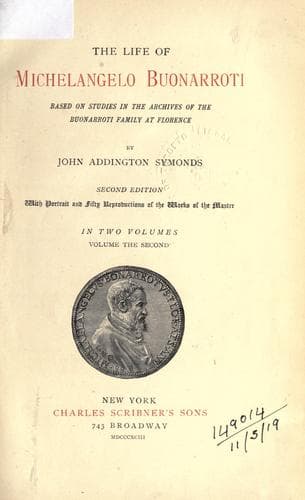
The Life of Michelangelo BuonarrotiSymonds, John Addington
History
The Life of Michelangelo Buonarroti
Symonds, John Addington
Michelangelo Buonarroti, 1475-1564
Time, negligence, and outrage, the dust of centuries, the burned
papers of successive conclaves, the smoke of altar-candles, the
hammers and the hangings of upholsterers, the brush of the
breeches-maker and restorer, have so dealt with the Last Judgment that
it is almost impossible to do it justice now. What Michelangelo
intended by his scheme of colour is entirely lost. Not only did
Daniele da Volterra, an execrable colourist, dab vividly tinted
patches upon the modulated harmonies of flesh-tones painted by the
master; but the whole surface has sunk into a bluish fog, deepening to
something like lamp-black around the altar. Nevertheless, in its
composition the fresco may still be studied; and after due inspection,
aided by photographic reproductions of each portion, we are not unable
to understand the enthusiasm which so nobly and profoundly planned a
work of art aroused among contemporaries.
It has sometimes been asserted that this enormous painting, the
largest and most comprehensive in the world, is a tempest of
contending forms, a hurly-burly of floating, falling, soaring, and
descending figures. Nothing can be more opposed to the truth.
Michelangelo was sixty-six years of age when he laid his brush down at
the end of the gigantic task. He had long outlived the spontaneity of
youthful ardour. His experience through half a century in the planning
of monuments, the painting of the Sistine vault, the designing of
façades and sacristies and libraries, had developed the architectonic
sense which was always powerful in his conceptive faculty.
Consequently, we are not surprised to find that, intricate and
confused as the scheme may appear to an unpractised eye, it is in
reality a design of mathematical severity, divided into four bands or
planes of grouping. The wall, since it occupies one entire end of a
long high building, is naturally less broad than lofty. The pictorial
divisions are therefore horizontal in the main, though so combined and
varied as to produce the effect of multiplied curves, balancing and
antiphonally inverting their lines of sinuosity. The pendentive upon
which the prophet Jonah sits, descends and breaks the surface at the
top, leaving a semicircular compartment on each side of its corbel.
Michelangelo filled these upper spaces with two groups of wrestling
angels, the one bearing a huge cross, the other a column, in the air.
The cross and whipping-post are the chief emblems of Christ's Passion.
The crown of thorns is also there, the sponge, the ladder, and the
nails. It is with no merciful intent that these signs of our Lord's
suffering are thus exhibited. Demonic angels, tumbling on clouds like
Leviathans, hurl them to and fro in brutal wrath above the crowd of
souls, as though to demonstrate the justice of damnation. In spite of
a God's pain and shameful death, mankind has gone on sinning. The
Judge is what the crimes of the world and Italy have made him.
Public-domain text, read in full here on John Shaqi.
Reviews
Reviews
No reviews yet
Be the first to share your thoughts on this work.
Elsewhere in the archive
Join the Discussion
Join the discussion
Sign in to leave a comment or review.
Sign InorCreate an account