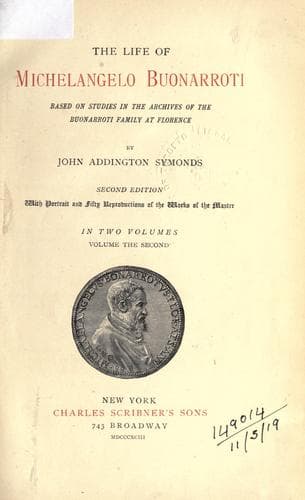
The Life of Michelangelo BuonarrotiSymonds, John Addington
History
The Life of Michelangelo Buonarroti
Symonds, John Addington
Michelangelo Buonarroti, 1475-1564
Vasari, in his description of the Last Judgment, seized upon what
after all endures as the most salient aspect of this puzzling work, at
once so fascinating and so repellent. "It is obvious," he says, "that
the peerless painter did not aim at anything but the portrayal of the
human body in perfect proportions and most varied attitudes, together
with the passions and affections of the soul. That was enough for him,
and here he has no equal. He wanted to exhibit the grand style:
consummate draughtsmanship in the nude, mastery over all problems of
design. He concentrated his power upon the human form, attending to
that alone, and neglecting all subsidiary things, as charm of colour,
capricious inventions, delicate devices and novelties of fancy."
Vasari might have added that Michelangelo also neglected what ought to
have been a main object of his art: convincing eloquence, the
solemnity proper to his theme, spirituality of earthly grossness quit.
As a collection of athletic nudes in all conceivable postures of rest
and action, of foreshortening, of suggested movement, the Last
Judgment remains a stupendous miracle. Nor has the aged master lost
his cunning for the portrayal of divinely simple faces, superb limbs,
masculine beauty, in the ideal persons of young men. The picture, when
we dwell long enough upon its details, emerges into prominence,
moreover, as indubitably awe-inspiring, terrifying, dreadful in its
poignant expression of wrath, retaliation, thirst for vengeance,
cruelty, and helpless horror. But the supreme point even of Doomsday,
of the Dies Irae, has not been seized. We do not hear the still small
voice of pathos and of human hope which thrills through Thomas a
Celano's hymn:--
_Quaerens me sedisti lassus,
Redemisti crucem passus:
Tantus labor non sit cassus._
The note is one of sustained menace and terror, and the total scheme
of congregated forms might be compared to a sense-deafening solo on a
trombone. While saying this, we must remember that it was the constant
impulse of Michelangelo to seize one moment only, and what he deemed
the most decisive moment, in the theme he had to develop. Having
selected the instant of time at which Christ, half risen from his
Judgment-seat of cloud, raises an omnific hand to curse, the master
caused each fibre of his complex composition to thrill with the
tremendous passion of that coming sentence. The long series of designs
for Crucifixions, Depositions from the Cross, and Pietàs which we
possess, all of them belonging to a period of his life not much later
than 1541, prove that his nature was quite as sensitive to pathos as
to terror; only, it was not in him to attempt a combination of terror
and pathos.
Public-domain text, read in full here on John Shaqi.
Reviews
Reviews
No reviews yet
Be the first to share your thoughts on this work.
Elsewhere in the archive
Join the Discussion
Join the discussion
Sign in to leave a comment or review.
Sign InorCreate an account