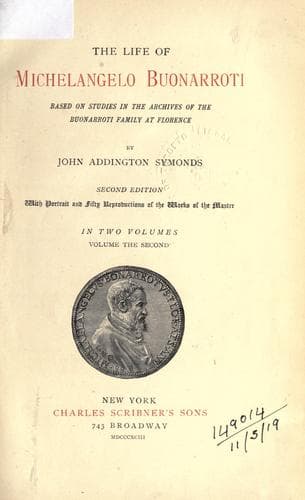
The Life of Michelangelo BuonarrotiSymonds, John Addington
History
The Life of Michelangelo Buonarroti
Symonds, John Addington
Michelangelo Buonarroti, 1475-1564
The two planes which I have attempted to describe occupy the upper and
the larger portion of the composition. The third in order is made up
of three masses. In the middle floats a band of Titanic cherubs,
blowing their long trumpets over earth and sea to wake the dead.
Dramatically, nothing can be finer than the strained energy and
superhuman force of these superb creatures. Their attitudes compel our
imagination to hear the crashing thunders of the trump of doom. To the
left of the spectator are souls ascending to be judged, some floating
through vague ether, enwrapped with grave-clothes, others assisted by
descending saints and angels, who reach a hand, a rosary, to help the
still gross spirit in its flight. To the right are the condemned,
sinking downwards to their place of torment, spurned by seraphs,
cuffed by angelic grooms, dragged by demons, hurling, howling, huddled
in a mass of horror. It is just here, and still yet farther down, that
Michelangelo put forth all his power as a master of expression. While
the blessed display nothing which is truly proper to their state of
holiness and everlasting peace, the damned appear in every realistic
aspect of most stringent agony and terror. The colossal forms of flesh
with which the multitudes of saved and damned are equally endowed,
befit that extremity of physical and mental anguish more than they
suit the serenity of bliss eternal. There is a wretch, twined round
with fiends, gazing straight before him as he sinks; one half of his
face is buried in his hand, the other fixed in a stony spasm of
despair, foreshadowing perpetuity of hell. Nothing could express with
sublimity of a higher order the sense of irremediable loss, eternal
pain, a future endless without hope, than the rigid dignity of this
not ignoble sinner's dread. Just below is the place to which the
doomed are sinking. Michelangelo reverted to Dante for the symbolism
chosen to portray hell. Charon, the demon, with eyes of burning coal,
compels a crowd of spirits in his ferryboat. They land and are
received by devils, who drag them before Minos, judge of the infernal
regions. He towers at the extreme right end of the fresco, indicating
that the nether regions yawn infinitely deep, beyond our ken; just as
the angels above Christ suggest a region of light and glory, extending
upward through illimitable space. The scene of judgment on which
attention is concentrated forms but an episode in the universal,
sempiternal scheme of things. Balancing hell, on the left hand of the
spectator, is brute earth, the grave, the forming and the swallowing
clay, out of which souls, not yet acquitted or condemned, emerge with
difficulty, in varied forms of skeletons or corpses, slowly thawing
into life eternal.
Public-domain text, read in full here on John Shaqi.
Reviews
Reviews
No reviews yet
Be the first to share your thoughts on this work.
Elsewhere in the archive
Join the Discussion
Join the discussion
Sign in to leave a comment or review.
Sign InorCreate an account