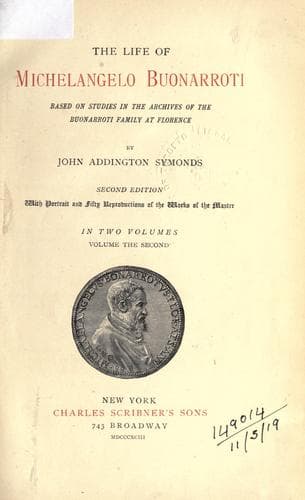
The Life of Michelangelo BuonarrotiSymonds, John Addington
History
The Life of Michelangelo Buonarroti
Symonds, John Addington
Michelangelo Buonarroti, 1475-1564
A group of two figures, sometimes called the Victory, now in the
Bargello Palace, was catalogued without hesitation by Vasari among the
statues for the tomb. A young hero, of gigantic strength and height,
stands firmly poised upon one foot, while his other leg, bent at the
knee, crushes the back of an old man doubled up beneath him. In the
face of the vanquished warrior critics have found a resemblance to
Michelangelo. The head of the victorious youth seems too small for his
stature, and the features are almost brutally vacuous, though burning
with an insolent and carnal beauty. The whole forcible figure
expresses irresistible energy and superhuman litheness combined with
massive strength. This group cannot be called pleasing, and its great
height renders it almost inconceivable that it was meant to range upon
one monument with the Captives of the Louvre. There are, however, so
many puzzles and perplexities connected with that design in its
several stages, that we dare affirm or deny nothing concerning it. M.
Guillaume, taking it for granted that the Victory was intended for the
tomb, makes the plausible suggestion that some of the peculiarities
which render it in composition awkward, would have been justified by
the addition of bronze wings. Mr. Heath Wilson, seeking after an
allegory, is fain to believe that it represents Michelangelo's own
state of subjection while employed upon the Serravezza quarries.
Last comes the so-called Adonis of the Bargello Palace, which not
improbably was designed for one of the figures prostrate below the
feet of a victorious Genius. It bears, indeed, much resemblance to a
roughly indicated nude at the extreme right of the sketch for the
tomb. Upon this supposition, Michelangelo must have left it in a very
unfinished state, with an unshaped block beneath the raised right
thigh. This block has now been converted into a boar. Extremely
beautiful as the Adonis undoubtedly is, the strained, distorted
attitude seems to require some explanation. That might have been given
by the trampling form and robes of a Genius. Still it is difficult to
comprehend why the left arm and hand, finished, I feel almost sure, by
Michelangelo, should have been so carefully executed. The Genius, if
draped, would have hidden nearly the whole of that part of the statue.
The face of this Adonis displays exactly the same type as that of the
so-called Victory and of Giuliano de' Medici. Here the type assumes
singular loveliness.
CHAPTER XII
I
Public-domain text, read in full here on John Shaqi.
Reviews
Reviews
No reviews yet
Be the first to share your thoughts on this work.
Elsewhere in the archive
Join the Discussion
Join the discussion
Sign in to leave a comment or review.
Sign InorCreate an account