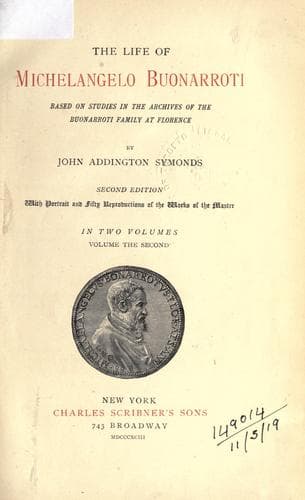
The Life of Michelangelo BuonarrotiSymonds, John Addington
History
The Life of Michelangelo Buonarroti
Symonds, John Addington
Michelangelo Buonarroti, 1475-1564
After the death of Clement VII. Michelangelo never returned to reside
at Florence. The rest of his life was spent in Rome. In the year 1534
he had reached the advanced age of fifty-nine, and it is possible that
he first became acquainted with the noble lady Vittoria Colonna about
1538. Recent students of his poetry and friendships have suggested
that their famous intimacy began earlier, during one of his not
infrequent visits to Rome. But we have no proof of this. On the
contrary, the only letters extant which he sent to her, two in number,
belong to the year 1545. It is certain that anything like friendship
between them grew up at some considerable time after his final
settlement in Rome.
Vittoria was the daughter of Fabrizio Colonna, Grand Constable of
Naples, by his marriage with Agnesina di Montefeltro, daughter of
Federigo, Duke of Urbino. Blood more illustrious than hers could not
be found in Italy. When she was four years old, her parents betrothed
her to Ferrante Francesco d'Avalos, a boy of the same age, the only
son of the Marchese di Pescara. In her nineteenth year the affianced
couple were married at Ischia, the fief and residence of the house of
D'Avalos. Ferrante had succeeded to his father's title early in
boyhood, and was destined for a brilliant military career. On the
young bride's side at least it was a love-match. She was tenderly
attached to her handsome husband, ignorant of his infidelities, and
blind to his fatal faults of character. Her happiness proved of short
duration. In 1512 Pescara was wounded and made prisoner at the battle
of Ravenna, and, though he returned to his wife for a short interval,
duty called him again to the field of war in Lombardy in 1515. After
this date Vittoria saw him but seldom. The last time they met was in
October 1522. As general of the Imperial forces, Pescara spent the
next years in perpetual military operations. Under his leadership the
battle of Pavia was won in 1525, and King Francis became his master's
prisoner. So far, nothing but honour, success, and glory waited on the
youthful hero. But now the tide turned. Pescara, when he again settled
down at Milan, began to plot with Girolamo Morone, Grand Chancellor of
Francesco Sforza's duchy. Morone had conceived a plan for reinstating
his former lord in Milan by the help of an Italian coalition. He
offered Pescara the crown of Naples if he would turn against the
Emperor. The Marquis seems at first to have lent a not unwilling ear
to these proposals, but seeing reason to doubt the success of the
scheme, he finally resolved to betray Morone to Charles V., and did
this with cold-blooded ingenuity. A few months afterwards, on November
25, 1525, he died, branded as a traitor, accused of double treachery,
both to his sovereign and his friend.
Public-domain text, read in full here on John Shaqi.
Reviews
Reviews
No reviews yet
Be the first to share your thoughts on this work.
Elsewhere in the archive
Join the Discussion
Join the discussion
Sign in to leave a comment or review.
Sign InorCreate an account