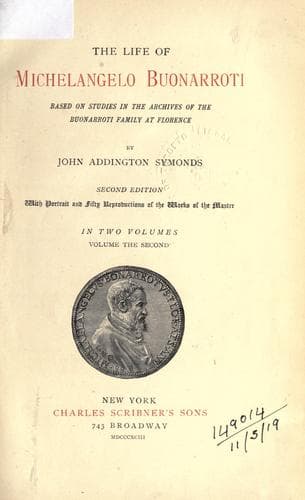
The Life of Michelangelo BuonarrotiSymonds, John Addington
History
The Life of Michelangelo Buonarroti
Symonds, John Addington
Michelangelo Buonarroti, 1475-1564
If suspicions of her husband's guilt crossed Vittoria's mind, as we
have some reason to believe they did, these were not able to destroy
her loyalty and love. Though left so young a widow and childless, she
determined to consecrate her whole life to his memory and to religion.
His nephew and heir, the Marchese del Vasto, became her adopted son.
The Marchioness survived Pescara two-and-twenty years, which were
spent partly in retirement at Ischia, partly in journeys, partly in
convents at Orvieto and Viterbo, and finally in a semi-monastic
seclusion at Rome. The time spared from pious exercises she devoted to
study, the composition of poetry, correspondence with illustrious men
of letters, and the society of learned persons. Her chief friends
belonged to that group of earnest thinkers who felt the influences of
the Reformation without ceasing to be loyal children of the Church.
With Vittoria's name are inseparably connected those of Gasparo
Contarini, Reginald Pole, Giovanni Morone, Jacopo Sadoleto,
Marcantonio Flaminio, Pietro Carnesecchi, and Fra Bernardino Ochino.
The last of these avowed his Lutheran principles, and was severely
criticised by Vittoria Colonna for doing so. Carnesecchi was burned
for heresy. Vittoria never adopted Protestantism, and died an orthodox
Catholic. Yet her intimacy with men of liberal opinions exposed her to
mistrust and censure in old age. The movement of the
Counter-Reformation had begun, and any kind of speculative freedom
aroused suspicion. This saintly princess was accordingly placed under
the supervision of the Holy Office, and to be her friend was slightly
dangerous. It is obvious that Vittoria's religion was of an
evangelical type, inconsistent with the dogmas developed by the
Tridentine Council; and it is probable that, like her friend
Contarini, she advocated a widening rather than a narrowing of Western
Christendom. To bring the Church back to purer morals and sincerity of
faith was their aim. They yearned for a reformation and regeneration
from within.
Public-domain text, read in full here on John Shaqi.
Reviews
Reviews
No reviews yet
Be the first to share your thoughts on this work.
Elsewhere in the archive
Join the Discussion
Join the discussion
Sign in to leave a comment or review.
Sign InorCreate an account