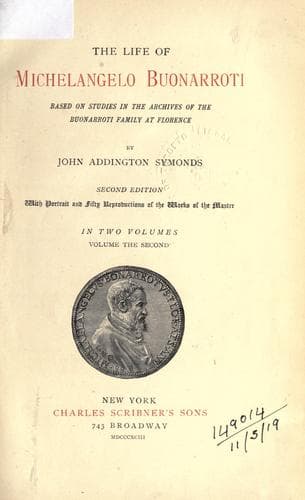
The Life of Michelangelo BuonarrotiSymonds, John Addington
History
The Life of Michelangelo Buonarroti
Symonds, John Addington
Michelangelo Buonarroti, 1475-1564
Unfortunately we possess no other document in prose addressed
immediately to Vittoria. But four of her letters to him exist, and
from these I will select some specimens reflecting light upon the
nature of the famous intimacy. The Marchioness writes always in the
tone and style of a great princess, adding that peculiar note of
religious affectionateness which the French call "_onction_," and
marking her strong admiration of the illustrious artist. The letters
are not dated; but this matters little, since they only turn on
literary courtesies exchanged, drawings presented, and pious interests
in common.
"Unique Master Michelangelo, and my most singular friend,--I have
received your letter, and examined the crucifix, which truly hath
crucified in my memory every other picture I ever saw. Nowhere could
one find another figure of our Lord so well executed, so living, and
so exquisitely finished. Certes, I cannot express in words how subtly
and marvellously it is designed. Wherefore I am resolved to take the
work as coming from no other hand but yours, and accordingly I beg you
to assure me whether this is really yours or another's. Excuse the
question. If it is yours, I must possess it under any conditions. In
case it is not yours, and you want to have it carried out by your
assistant, we will talk the matter over first. I know how extremely
difficult it would be to copy it, and therefore I would rather let him
finish something else than this. But if it be in fact yours, rest
assured, and make the best of it, that it will never come again into
your keeping. I have examined it minutely in full light and by the
lens and mirror, and never saw anything more perfect.--Yours to
command,
"The Marchioness of Pescara."
Like many grand ladies of the highest rank, even though they are
poetesses, Vittoria Colonna did not always write grammatically or
coherently. I am not therefore sure that I have seized the exact
meaning of this diplomatical and flattering letter. It would appear,
however, that Michelangelo had sent her the drawing for a crucifix,
intimating that, if she liked it, he would intrust its execution to
one of his workmen, perhaps Urbino. This, as we know, was a common
practice adopted by him in old age, in order to avoid commissions
which interfered with his main life-work at S. Peter's. The noble
lady, fully aware that the sketch is an original, affects some doubt
upon the subject, declines the intervention of a common craftsman, and
declares her firm resolve to keep it, leaving an impression that she
would gladly possess the crucifix if executed by the same hand which
had supplied the masterly design.
Another letter refers to the drawing of a Christ upon the cross
between two angels.
Public-domain text, read in full here on John Shaqi.
Reviews
Reviews
No reviews yet
Be the first to share your thoughts on this work.
Elsewhere in the archive
Join the Discussion
Join the discussion
Sign in to leave a comment or review.
Sign InorCreate an account