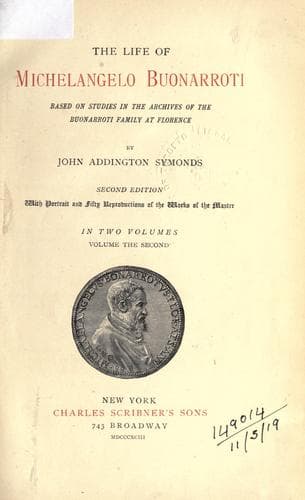
The Life of Michelangelo BuonarrotiSymonds, John Addington
History
The Life of Michelangelo Buonarroti
Symonds, John Addington
Michelangelo Buonarroti, 1475-1564
"Your works forcibly stimulate the judgment of all who look at them.
My study of them made me speak of adding goodness to things perfect in
themselves, and I have seen now that 'all is possible to him who
believes.' I had the greatest faith in God that He would bestow upon
you supernatural grace for the making of this Christ. When I came to
examine it, I found it so marvellous that it surpasses all my
expectations. Wherefore, emboldened by your miracles, I conceived a
great desire for that which I now see marvellously accomplished: I
mean that the design is in all parts perfect and consummate, and one
could not desire more, nor could desire attain to demanding so much. I
tell you that I am mighty pleased that the angel on the right hand is
by far the fairer, since Michael will place you, Michelangelo, upon
the right hand of our Lord at that last day. Meanwhile, I do not know
how else to serve you than by making orisons to this sweet Christ,
whom you have drawn so well and exquisitely, and praying you to hold
me yours to command as yours in all and for all."
The admiration and the good-will of the great lady transpire in these
somewhat incoherent and studied paragraphs. Their verbiage leaves much
to be desired in the way of logic and simplicity. It is pleasanter
perhaps to read a familiar note, sent probably by the hand of a
servant to Buonarroti's house in Rome.
"I beg you to let me have the crucifix a short while in my keeping,
even though it be unfinished. I want to show it to some gentlemen who
have come from the Most Reverend the Cardinal of Mantua. If you are
not working, will you not come to-day at your leisure and talk with
me?--Yours to command,
"The Marchioness of Pescara."
It seems that Michelangelo's exchange of letters and poems became at
last too urgent. We know it was his way (as in the case of Luigi del
Riccio) to carry on an almost daily correspondence for some while, and
then to drop it altogether when his mood changed. Vittoria, writing
from Viterbo, gives him a gentle and humorous hint that he is taking
up too much of her time:
Public-domain text, read in full here on John Shaqi.
Reviews
Reviews
No reviews yet
Be the first to share your thoughts on this work.
Elsewhere in the archive
Join the Discussion
Join the discussion
Sign in to leave a comment or review.
Sign InorCreate an account