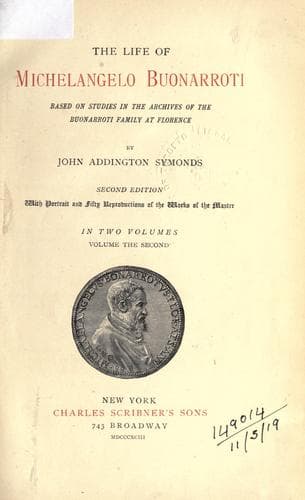
The Life of Michelangelo BuonarrotiSymonds, John Addington
History
The Life of Michelangelo Buonarroti
Symonds, John Addington
Michelangelo Buonarroti, 1475-1564
"Magnificent Messer Michelangelo,--I did not reply earlier to your
letter, because it was, as one might say, an answer to my last: for I
thought that if you and I were to go on writing without intermission
according to my obligation and your courtesy, I should have to neglect
the Chapel of S. Catherine here, and be absent at the appointed hours
for company with my sisterhood, while you would have to leave the
Chapel of S. Paul, and be absent from morning through the day from
your sweet usual colloquy with painted forms, the which with their
natural accents do not speak to you less clearly than the living
persons round me speak to me. Thus we should both of us fail in our
duty, I to the brides, you to the vicar of Christ. For these reasons,
inasmuch as I am well assured of our steadfast friendship and firm
affection, bound by knots of Christian kindness, I do not think it
necessary to obtain the proof of your good-will in letters by writing
on my side, but rather to await with well-prepared mind some
substantial occasion for serving you. Meanwhile I address my prayers
to that Lord of whom you spoke to me with so fervent and humble a
heart when I left Rome, that when I return thither I may find you with
His image renewed and enlivened by true faith in your soul, in like
measure as you have painted it with perfect art in my Samaritan.
Believe me to remain always yours and your Urbino's."
This letter must have been written when Michelangelo was still working
on the frescoes of the Cappella Paolina, and therefore before 1549.
The check to his importunacy, given with genial tact by the
Marchioness, might be taken, by those who believe their _liaison_ to
have had a touch of passion in it, as an argument in favour of that
view. The great age which Buonarroti had now reached renders this,
however, improbable; while the general tenor of their correspondence
is that of admiration for a great artist on the lady's side, and of
attraction to a noble nature on the man's side, cemented by religious
sentiment and common interests in serious topics.
III
Public-domain text, read in full here on John Shaqi.
Reviews
Reviews
No reviews yet
Be the first to share your thoughts on this work.
Elsewhere in the archive
Join the Discussion
Join the discussion
Sign in to leave a comment or review.
Sign InorCreate an account