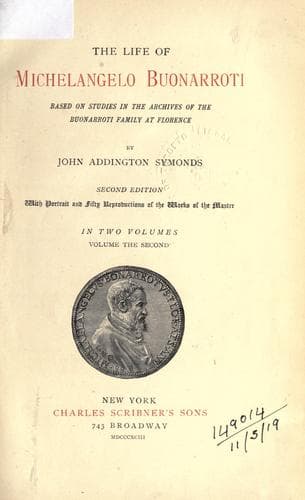
The Life of Michelangelo BuonarrotiSymonds, John Addington
History
The Life of Michelangelo Buonarroti
Symonds, John Addington
Michelangelo Buonarroti, 1475-1564
The conversation passed by natural degrees to a consideration of the
fine arts in general. In the course of this discussion, Michelangelo
uttered several characteristic opinions, strongly maintaining the
superiority of the Italian to the Flemish and German schools, and
asserting his belief that, while all objects are worthy of imitation
by the artist, the real touch stone of excellence lies in his power to
represent the human form. His theory of the arts in their reciprocal
relations and affinities throws interesting light upon the qualities
of his own genius and his method in practice. "The science of design,
or of line-drawing, if you like to use this term, is the source and
very essence of painting, sculpture, architecture, and of every form
of representation, as well too as of all the sciences. He who has made
himself a master in this art possesses a great treasure. Sometimes,
when I meditate upon these topics, it seems to me that I can discover
but one art or science, which is design, and that all the works of the
human brain and hand are either design itself or a branch of that
art." This theme he develops at some length, showing how a complete
mastery of drawing is necessary not only to the plastic arts of
painting and sculpture, but also to the constructive and mechanical
arts of architecture, fortification, gun-foundry, and so forth,
applying the same principle to the minutest industries.
With regard to the personal endowments of the artist, he maintained
that "a lofty style, grave and decorous, was essential to great work.
Few artists understand this, and endeavour to appropriate these
qualities. Consequently we find many members of the confraternity who
are only artists in name. The world encourages this confusion of
ideas, since few are capable of distinguishing between a fellow who
has nothing but his colour-box and brushes to make him a painter, and
the really gifted natures who appear only at wide intervals." He
illustrates the position that noble qualities in the artist are
indispensable to nobility in the work of art, by a digression on
religious painting and sculpture. "In order to represent in some
degree the adored image of our Lord, it is not enough that a master
should be great and able. I maintain that he must also be a man of
good conduct and morals, if possible a saint, in order that the Holy
Ghost may rain down inspiration on his understanding. Ecclesiastical
and secular princes ought, therefore, to permit only the most
illustrious among the artists of their realm to paint the benign
sweetness of our Saviour, the purity of our Lady, and the virtues of
the saints. It often happens that ill-executed images distract the
minds of worshippers and ruin their devotion, unless it be firm and
fervent. Those, on the contrary, which are executed in the high style
I have described, excite the soul to contemplation and to tears, even
among the least devout, by inspiring reverence and fear through the
Public-domain text, read in full here on John Shaqi.
Reviews
Reviews
No reviews yet
Be the first to share your thoughts on this work.
Elsewhere in the archive
Join the Discussion
Join the discussion
Sign in to leave a comment or review.
Sign InorCreate an account