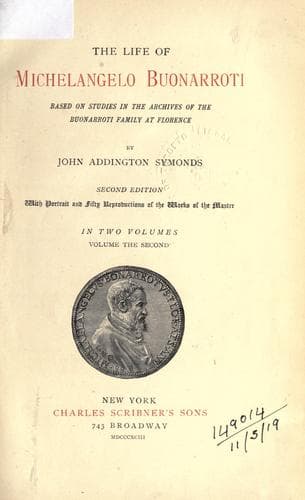
The Life of Michelangelo BuonarrotiSymonds, John Addington
History
The Life of Michelangelo Buonarroti
Symonds, John Addington
Michelangelo Buonarroti, 1475-1564
majesty of their aspect." This doctrine is indubitably sound. To our
minds, nevertheless, it rings a little hollow on the lips of the great
master who modelled the Christ of the Minerva and painted the Christ
and Madonna of the Last Judgment. Yet we must remember that, at the
exact period when these dialogues took place, Buonarroti, under the
influence of his friendship with Vittoria Colonna, was devoting his
best energies to the devout expression of the Passion of our Lord. It
is deeply to be regretted that, out of the numerous designs which
remain to us from this endeavour, all of them breathing the purest
piety, no monumental work except the Pietà at Florence emerged for
perpetuity.
Many curious points, both of minute criticism and broad opinion, might
still be gleaned from the dialogues set down by Francis of Holland. It
must suffice here to resume what Michelangelo maintained about the
artist's method. One of the interlocutors begged to be informed
whether he thought that a master ought to aim at working slowly or
quickly. "I will tell you plainly what I feel about this matter. It is
both good and useful to be able to work with promptitude and address.
We must regard it as a special gift from God to be able to do that in
a few hours which other men can only perform in many days of labour.
Consequently, artists who paint rapidly, without falling in quality
below those who paint but slowly, deserve the highest commendation.
Should this rapidity of execution, however, cause a man to transgress
the limits of sound art, it would have been better to have proceeded
with more tardiness and study. A good artist ought never to allow the
impetuosity of his nature to overcome his sense of the main end of
art, perfection. Therefore we cannot call slowness of execution a
defect, nor yet the expenditure of much time and trouble, if this be
employed with the view of attaining greater perfection. The one
unpardonable fault is bad work. And here I would remind you of a thing
essential to our art, which you will certainly not ignore, and to
which I believe you attach the full importance it deserves. In every
kind of plastic work we ought to strive with all our might at making
what has cost time and labour look as though it had been produced with
facility and swiftness. It sometimes happens, but rarely, that a
portion of our work turns out excellent with little pains bestowed
upon it. Most frequently, however, it is the expenditure of care and
trouble which conceals our toil. Plutarch relates that a bad painter
showed Apelles a picture, saying: 'This is from my hand; I have just
made it in a moment.' The other replied: 'I should have recognised the
fact without your telling me; and I marvel that you do not make a
multitude of such things every day.'" Michelangelo is reported to have
made a similar remark to Vasari when the latter took him to inspect
some frescoes he had painted, observing that they had been dashed off
quickly.
Public-domain text, read in full here on John Shaqi.
Reviews
Reviews
No reviews yet
Be the first to share your thoughts on this work.
Elsewhere in the archive
Join the Discussion
Join the discussion
Sign in to leave a comment or review.
Sign InorCreate an account