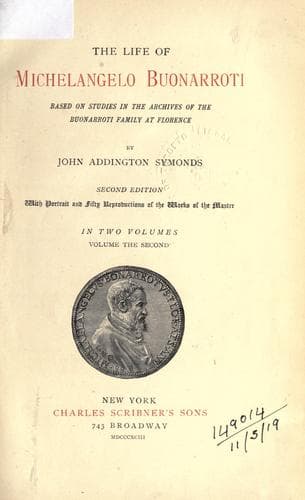
The Life of Michelangelo BuonarrotiSymonds, John Addington
History
The Life of Michelangelo Buonarroti
Symonds, John Addington
Michelangelo Buonarroti, 1475-1564
We must be grateful to Francis of Holland for this picture of the
Sunday-morning interviews at S. Silvestro. The place was cool and
tranquil. The great lady received her guests with urbanity, and led
the conversation with highbred courtesy and tact. Fra Ambrogio, having
discoursed upon the spiritual doctrines of S. Paul's Epistles, was at
liberty to turn an attentive ear to purely aesthetical speculations.
The grave and elderly Lattanzio Tolomei added the weight of philosophy
and literary culture to the dialogue. Michelangelo, expanding in the
genial atmosphere, spoke frankly on the arts which he had mastered,
not dictating _ex cathedra_ rules, but maintaining a note of modesty
and common-sense and deference to the opinion of others. Francis
engaged on equal terms in the discussion. His veneration for
Buonarroti, and the eagerness with which he noted all the great man's
utterances, did not prevent him from delivering lectures at a somewhat
superfluous length. In short, we may fairly accept his account of
these famous conferences as a truthful transcript from the refined and
witty social gatherings of which Vittoria Colonna formed the centre.
IV
This friendship with Vittoria Colonna forms a very charming episode in
the history of Michelangelo's career, and it was undoubtedly one of
the consolations of his declining years. Yet too great stress has
hitherto been laid on it by his biographers. Not content with
exaggerating its importance in his life, they have misinterpreted its
nature. The world seems unable to take interest in a man unless it can
contrive to discover a love-affair in his career. The singular thing
about Michelangelo is that, with the exception of Vittoria Colonna, no
woman is known to have influenced his heart or head in any way. In his
correspondence he never mentions women, unless they be aunts, cousins,
grand-nieces, or servants. About his mother he is silent. We have no
tradition regarding amours in youth or middle age; and only two words
dropped by Condivi lead us to conjecture that he was not wholly
insensible to the physical attractions of the female. Romancers and
legend-makers have, therefore, forced Vittoria Colonna to play the
rôle of Juliet in Michelangelo's life-drama. It has not occurred to
these critics that there is something essentially disagreeable in the
thought of an aged couple entertaining an amorous correspondence. I
use these words deliberately, because poems which breathe obvious
passion of no merely spiritual character have been assigned to the
number he composed for Vittoria Colonna. This, as we shall see, is
chiefly the fault of his first editor, who printed all the sonnets and
madrigals as though they were addressed to one woman or another. It is
also in part due to the impossibility of determining their exact date
in the majority of instances. Verses, then, which were designed for
several objects of his affection, male or female, have been
Public-domain text, read in full here on John Shaqi.
Reviews
Reviews
No reviews yet
Be the first to share your thoughts on this work.
Elsewhere in the archive
Join the Discussion
Join the discussion
Sign in to leave a comment or review.
Sign InorCreate an account