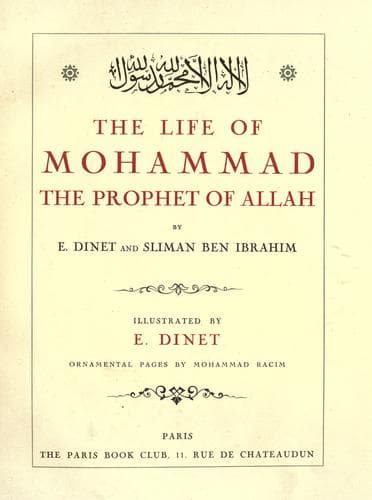
The Life of Mohammad, the Prophet of AllahDinet, Etienne
Religion
The Life of Mohammad, the Prophet of Allah
Dinet, Etienne
Muhammad, Prophet, -632
Such moral and physical well-being, that he owed to the Badya, was of
great help to him, during ordeals later in life. He was always pleased
to recur to his childhood's days. 'Allah granted me two inestimable
favours,' he would often say. 'First came the privilege of being born
in the most noble of all the Arab tribes, the Quraish; secondly, that
of being brought up in the Bani Sad region, the most salubrious of the
entire Hijaz.'
Never were there effaced from his mind those pictures of the desert
which were impressed on his earliest glances when, in company with
other nomadic lads, he would climb to the top of a rock to watch over
a grazing flock.
Notwithstanding, being inclined to dream and meditate, he did not
agree very well with the turbulence and high spirits of the little
Bedouins of his own age, and preferred to hide away from them, and
ramble in solitude not too far from the tents.
[Sidenote: MOHAMMAD AND THE TWO ANGELS]
He went out, one morning, with his foster-brother leading the flocks
of his foster-father to the pasturage.
All of a sudden, about the middle of the day, Mohammad's young
companion went back alone. 'Come hither quickly!' he shouted to his
father and mother, his voice hoarse with affright. 'My brother, the
Quraish, having slipped away from us, according to his wont, two men,
clothed all in white, seized hold of him, threw him on the ground and
split his chest open.'
In mad fear, poor Halimah, followed by her husband, ran as fast as her
legs would carry her, following the road pointed out by the youthful
shepherd. Mohammad was found seated on the top of a hill. He was
perfectly calm, but his face had taken on the sinister tint of the
dust and ashes to which we must all return. They fondled him gently
and put question after question to him. 'What ails thee, O child of
ours? What hath befell thee?'--'While I was intent upon looking after
the grazing sheep,' he replied, 'I saw two white forms appear. At
first, I took them to be two great birds, but as they drew nearer, I
saw my mistake: they were two men clad in tunics of dazzling
whiteness.'--'Is that the boy?' said one of them to his companion,
pointing to me. 'Yea! 'Tis he!' As I stood stupefied with fear, they
seized me; threw me down and cut my breast open. They drew out of my
heart a black clot of blood which they cast far away; and then closing
up my chest, they disappeared like phantoms.'
The words of Allah, in the Qur'an, seem to allude to this incident:
"_Have we not opened thy breast for thee? * And taken off from thee
thy burden. * Which galled thy back?_" (THE QUR'AN, XCIV. 1, 2, 3).
This story, together with many others to be met with in the pages of
this work, must be taken to be a parable, which, in this case,
signifies that Allah opened Mohammad's breast when quite young, so
that the joy of monotheistic truth should penetrate therein and
permeate his being, relieving him of the heavy burden of idol-worship.
Public-domain text, read in full here on John Shaqi.
Reviews
Reviews
No reviews yet
Be the first to share your thoughts on this work.
Join the Discussion
Join the discussion
Sign in to leave a comment or review.
Sign InorCreate an account