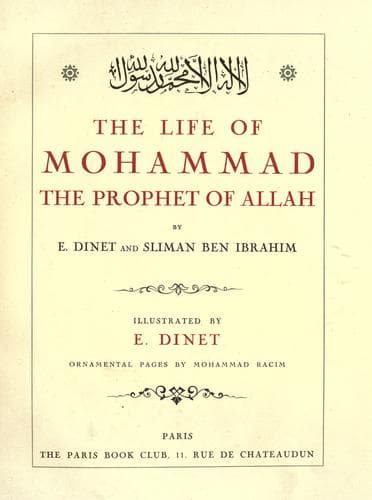
The Life of Mohammad, the Prophet of AllahDinet, Etienne
Religion
The Life of Mohammad, the Prophet of Allah
Dinet, Etienne
Muhammad, Prophet, -632
The Prophet then ordered Bilal to call the Faithful to prayer. When
the idolaters heard the resounding accents of the black freed slave,
reverberating in the echoes of the valley, they were so deeply annoyed
that they envied the fate of their illustrious dead, Abu Jabal and Abu
Lahab, prevented from hearing this call by the weight of the earth
piled on their graves. After the prayer, Mohammad again bestrode his
she-camel, to perform the "Sa'y" which is the run between the two
hills of Safa and Marwa. His example swept away the Believers'
scruples; for until then, they had hesitated about going through this
ceremony, being embarrassed by the presence of the idols Isaf and
Na'ila, set up at that spot.
By the performance of these rites, instituted by Abraham and
perpetuated by the Arabs, the Prophet had in view a nationalist and
political goal, which he wished to combine with his religious aims. If
he kissed the Black Stone, it was not by reason of a feeling of
superstitious worship which would have contradicted all the principles
of the Qur'an much too flagrantly, but solely through a feeling of
reverence for this relic of his glorious ancestor.
Quoth Ibn Abi Shayba, following Isa ibn Talha: "Addressing the Black
Stone, the Prophet declared: Verily, I know that thou art nothing more
than a stone, powerless to do harm, or be of any use. Then he kissed
it.... In this conjuncture, Abu Bakr, followed by Umar, one after the
other, came and kissed it, declaring: By Allah! I know that thou art
nothing more than a stone, powerless to do harm or be of any use, and
if I had not seen the Prophet kiss thee, I should not have kissed
thee!"
In like fashion, by the "Sa'y" and the ablutions at the well of
Zamzam, Mohammad kept alive the touching remembrance of the Arab's
ancestor Ishmael and of his mother Hajar (Hagar). "Being too weak to
carry any farther her wretched child succumbing athirst in a horrible
desert, Hajar placed her offspring on the ground in the shade of a
shrub and ascended a hill, hoping to see from afar a well or spring;
but all in vain. Then, fearing that the soul of Ishmael might have
escaped from his body, she came back, panting, to his side, and
climbed another hill for the same purpose, but with no more success
than before. So she went down again, tortured by the same anguish.
"Seven times did she run in despair between the two hills until,
maddened, she thought she would only find a corpse, when she caught
sight of her beloved son quenching his thirst at a spring which, by
order of the Compassionate, had gushed forth under the heel of the
poor child. And to this miraculous well was given the name of Zamzam."
In imitation of Hajar, pilgrims pass seven times along the path of
agony which she trod between the two hills known as Safa and Marwa,
and it is their duty to drink and perform their ablutions at the
Zamzam spring.
Public-domain text, read in full here on John Shaqi.
Reviews
Reviews
No reviews yet
Be the first to share your thoughts on this work.
Elsewhere in the archive
Join the Discussion
Join the discussion
Sign in to leave a comment or review.
Sign InorCreate an account