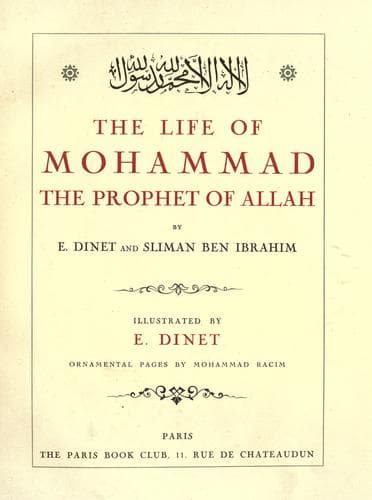
The Life of Mohammad, the Prophet of AllahDinet, Etienne
Religion
The Life of Mohammad, the Prophet of Allah
Dinet, Etienne
Muhammad, Prophet, -632
On the following day, in commemoration of the sacrifice of Abraham,
the victims were immolated in the valley of Mina. Their flesh was
shared among the pilgrims who, having shaved their heads, were once
again in the state of "halal," ordinary life, which they had
relinquished since Zu'l-Holifah.
While still in the state of "ihram," Mohammad, thanks to the special
privilege derived from his position as Allah's Messenger, married a
woman of Makkah, named Maimunah. She was fifty years of age and
extremely poor; but this matrimonial alliance was bound to bring
notable recruits to Islam. In the first place, her brother-in-law,
Al-Abbas, was Mohammad's uncle. He was her "wakil," or guardian, and
decreed her union with the Prophet. But the marriage was only
consummated at the first halt on the return journey to Al-Madinah.
Despite the rage of the idolatrous Quraish, who could not bear to look
upon the sight of their enemy's pilgrimage, the Prophet had gained his
end: to inform the Arabs of the whole of the Peninsula that he had no
intention of abolishing their secular traditions; but on the contrary,
would devote all his efforts to consolidate them, by restoring their
primitive purity.
The "Amratu'l-Qada" was thus the cause of great reaction; bringing
about immediate conversions; among others, those of three great
personages: Uthman ibn Talha, Amr ibnu'l-As and Khalid ibn Walid,
besides preparing the minds of the majority of the Arabs to follow
their example.
[Sidenote: THE PROPHET SENDS AMBASSADORS TO THE PRINCIPAL MONARCHS OF
THE WORLD]
The definitive defeat of the Jews rallied a great part of Arabia to
the Prophet; and the rest of the Peninsula was fatally bound, in
course of time, to come under the sway of Islam.
It was then that Mohammad turned towards neighbouring empires. Allah's
presence filled the universe and Islam, which counted already in its
ranks disciples of many different origins, was not destined to be
merely confined to the land of the Arabs. It spread over the whole
world. As it is written in the Qur'an: "_We have not sent thee
otherwise than to mankind at large._" (XXXIV, 27).
To the most powerful monarchs of Europe, therefore, Mohammad
despatched envoys carrying letters inviting those potentates to
embrace the religion of Allah, the Only One; and the missives bore a
seal on which the Prophet had caused to be engraved these words, set
out in three lines: "From Allah--the Prophet--Mohammad."
On receipt of the message, Al-Mundhir, King of Bahrayn, and Badhan,
Persian Satrap of Yaman, became converts to Islam. Al-Muqawqas,
Viceroy of Egypt, sent rich presents, among which, as well as Duldul,
a white mule, and Ya'fur, an ass, was a young slave, Mary the Copt.
She at once became Mohammad's concubine. Hirqal, (Heraclius), the
Roman Emperor, and the Najashi, (Negus), of Abyssinia, both replied by
most courteous letters.
Public-domain text, read in full here on John Shaqi.
Reviews
Reviews
No reviews yet
Be the first to share your thoughts on this work.
Elsewhere in the archive
Join the Discussion
Join the discussion
Sign in to leave a comment or review.
Sign InorCreate an account