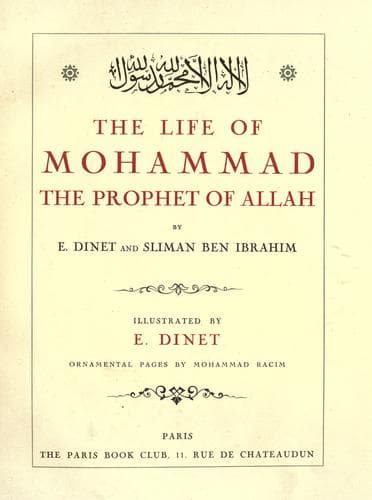
The Life of Mohammad, the Prophet of AllahDinet, Etienne
Religion
The Life of Mohammad, the Prophet of Allah
Dinet, Etienne
Muhammad, Prophet, -632
Kesra (Chosroes), King of Persia, swore he would punish the Prophet
for his audacity and the Almighty immediately chastised the monarch,
for he was murdered by his son Shiru'e, (Siroes), who took his
father's place on the throne. Al-Harith, son of Abu Shamar, was fated
to see his kingdom torn asunder, even as he had torn the letters
delivered to him by the Prophet's envoy.
Only one of these ambassadors, Al-Harith ibn Amr, was received with
contumely and afterwards treacherously murdered near Karak in the
Balqua region, following orders given by Shurabil al-Ghassani who
governed this region under Roman rule.
[Sidenote: THE EXPEDITION OF MUTAH (_Year VII of the Hegira, A.D.
629_)]
When the news of the outrage on his ambassador came to the Prophet's
ears, he determined to be instantly avenged, although he did not
conceal from himself the dangers of the undertaking.
This time the Believers had to face, not only the Syrian Arabs,
outnumbering those of the Hijaz, but also the Roman troops who
occupied the Balqua-Land. The Prophet placed Zayd ibn Al-Haris at the
head of three thousand men; but foreseeing that in this unequal
struggle, his army might be deprived of its leader, he nominated in
advance, as successor, Jafar, son of Abu Talib; and if misfortune
befell Jafar, Abdullah ibn Rawaha; and lastly, in the case of anything
unluckily happening to the latter, it was left to the soldiers to
choose a commander themselves.
A Jew was present at the council of war and made the following
remarks: 'O Abul Qasim! (a surname of Mohammad), if thou art really a
Prophet, all the men thou hast appointed are irretrievably lost. When
our prophets of Israel, after having placed a general at the head of
their armies, used to add: 'and, if he is killed, name such an one in
his place,' that infallibly meant that he was bound to lose his life.'
Then, turning to Zayd, he went on: 'I swear to thee that if Mohammad
is a true Prophet, thou wilt never return from this expedition.' Zayd
replied simply: 'I swear to thee that Mohammad is the Prophet of
Allah.' Then the Apostle tied the white "Liwa" (flag) to a spearhead
and gave it into the hands of Zayd.
Filled with funereal sentiments, Mohammad accompanied his troops to
Saniyat-ul-Wida, (the Pass of Farewells). It was there that he halted
and gave them his final instructions: 'Remain ever in fear of Allah.
Fight in his name and kill His foes who are yours. But leave in peace
such men as dwell in the seclusion of monasteries. Spare women,
children and the blind. Destroy no monuments; cut down no trees; and
when ye shall have avenged the death of Al-Harith ibn Amr, summon the
Arab tribes of Syria to Islam.'
Shurahbil, anxious as to the results of his cowardly outrage, called
upon all the Arabs of the surrounding country: the Banu Bahra, the
Banu Lakhm, the Judham, the Baliyy, etc., and he notified his fears to
Theodurus, lieutenant of Heraclius, who sent him all the Roman troops
then occupying the land.
Public-domain text, read in full here on John Shaqi.
Reviews
Reviews
No reviews yet
Be the first to share your thoughts on this work.
Elsewhere in the archive
Join the Discussion
Join the discussion
Sign in to leave a comment or review.
Sign InorCreate an account