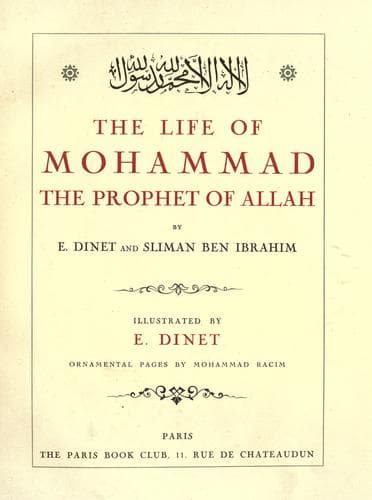
The Life of Mohammad, the Prophet of AllahDinet, Etienne
Religion
The Life of Mohammad, the Prophet of Allah
Dinet, Etienne
Muhammad, Prophet, -632
Again the fates decreed, that Mohammad should be deprived of gentle
love: Abdul Muttalib died at the age of ninety-five, unanimously
regretted by his fellow-citizens.
The unlucky orphan boy was received into the house of his uncle Abu
Talib, who had been chosen for this kind succour by his grandsire, for
the reason that, alone among his uncles, he was the brother of both
the mother and father of Abdullah, Mohammad's father.
[Sidenote: MOHAMMAD'S FIRST JOURNEY IN SYRIA (_A.D. 582_)]
Having a large family and not being very well off, although the
management of the Ka'bah had been bequeathed to him, Abu Talib was
obliged to do business with the lands of Yaman and Syria.
Shortly after sheltering his nephew under his roof, he undertook the
task of organising a caravan of Quraish men, and he was to lead them
back to their tents.
All was in readiness; the loads were shared and divided, corded and
balanced on the pack-saddles of the kneeling camels, grunting
according to their habit. Their drivers began, by dint of blows and
shouts, to force them to rise to their feet and direct their swaying
stride in a northerly direction. This sight caused Mohammad to
remember his beloved Badya, where caravans resembling this one about
to depart passed to and fro continually. Fresh separation, this time
from his beloved uncle, was about to plunge him into the sadness of
solitude. He stood still, gloomy and silent. At last, heartbroken, he
threw himself into Abu Talib's embrace, casting his young arms round
him, and hiding his face in the folds of his uncle's mantle, to
conceal his tears brought on by longing and despair.
Greatly moved by this spontaneous manifestation of affection, and
guessing how ardent was his nephew's wish to accompany him, Abu Talib
declared: 'By Allah! we'll take him with us; he'll not leave me and
I'll not leave him.'
Mohammad dried his tears and, jumping for joy, he busied himself in
hastening the final preparations for the journey. At a sign from his
uncle, he perched himself on the female camel, getting up behind him.
When the caravan began to pass along the tracks made by the Bedouin
tribes, Mohammad's lungs, contracted by breathing the vitiated air of
houses and streets, were deliciously dilated, revelling in liberally
gulping down the life-giving air of the Badya to which he was
accustomed. Being used to a nomadic existence from childhood, the
young traveller was able to support most valiantly the exhausting
privations and terrible fatigue of such an interminable journey in the
midst of the Hijaz deserts.
For more than a year, the countries he passed through were so much
alike in their sands and rocks, that the caravan seemed as if marking
time. In the pitiless desert there was no other sign of life, except
the presence of Him who is everywhere, eternally existant, but not to
be seen by mortal eyes.
[Sidenote: HOW MOHAMMAD MET THE MONK BAHIRA]
Public-domain text, read in full here on John Shaqi.
Reviews
Reviews
No reviews yet
Be the first to share your thoughts on this work.
Join the Discussion
Join the discussion
Sign in to leave a comment or review.
Sign InorCreate an account