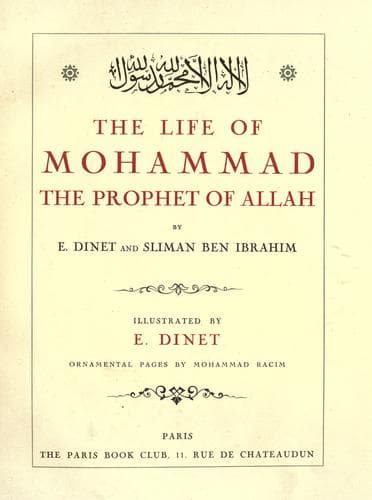
The Life of Mohammad, the Prophet of AllahDinet, Etienne
Religion
The Life of Mohammad, the Prophet of Allah
Dinet, Etienne
Muhammad, Prophet, -632
"When I came back and found my camel gone, I shouted despairingly; but
all in vain, until overcome by fatigue, I dropped down and fell
asleep. One of the rearguards, Safwan Ibnu'l-Mu'attal, catching sight
of me, recognised me and cried out: 'To Allah we belong and to Him
shall we return!' Having awakened me by this exclamation, he brought
up his camel, helping me into the saddle, and he led the animal by the
bridle until we rejoined the Prophet."
Scandalmongers got hold of the story and ascribed shameful motives to
this chance meeting. Despite the accused woman's protestations of
innocence, Mohammad felt suspicion gnawing at his heart, and he kept
Ayishah at a distance, greatly to the confusion of his father-in-law,
Abu Bakr.
At last, a Revelation called the accusers liars, and condemned
calumny: "_With Allah it was a grave matter_," (THE QUR'AN, XXIV, 14),
thus ridding the Prophet of all suspicion and putting an end to a
painful situation.
[Sidenote: THE BIRTH AND DEATH OF IBRAHIM]
In Year VIII of the Hegira, Mary, the Coptic concubine, gave birth to
a boy. The Prophet, who had never found consolation for the death of
his sons brought into the world by Khadijah, was beside himself with
joy. He gave a slave as a present to Abu Rafi'a, for having brought
the news that a son was born, and Mohammad declared that the child's
advent freed the mother.
On the seventh day, the baby's hair was shaved off and buried; two
sheep were sacrificed and alms were distributed to the poor. All the
wet-nurses vied with each other for the honour of suckling the
Prophet's son, who was called Ibrahim. He was given into the care of
Umm Burda, wife of Al-Bara ibn Aws, and she, was rewarded by the gift
of a palm-garden.
She took her nursling into the country, to the Banu Mazin, where the
Prophet went frequently to see his son. He used to take him in his
arms, unceasingly "smelling" him and covering him with kisses. The
affection he felt for the child's mother, Mary the Copt, also
increased, much to the great vexation of his other wives.
It happened, too, that he broke his strictly impartial household laws,
and granted Mary a night that rightly belonged to Hafsa, Umar's
daughter. She was grieved to the heart by her rights being forgotten
and reproached Mohammad so bitterly that he promised to cease all
intercourse with his freed slave on condition that Hafsa held her
tongue. But haughty Hafsa broke her word. She told her grievances to
Ayishah, who was likewise furiously exasperated at the favour shown to
Mary. It was now the turn of Hafsa to rouse the indignation of the
other joint wives.
Public-domain text, read in full here on John Shaqi.
Reviews
Reviews
No reviews yet
Be the first to share your thoughts on this work.
Elsewhere in the archive
Join the Discussion
Join the discussion
Sign in to leave a comment or review.
Sign InorCreate an account