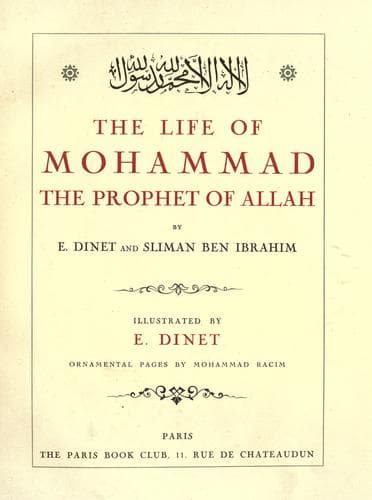
The Life of Mohammad, the Prophet of AllahDinet, Etienne
Religion
The Life of Mohammad, the Prophet of Allah
Dinet, Etienne
Muhammad, Prophet, -632
Scenes, scandal and shrieks caused life to be unbearable; so,
renouncing all consideration and refusing to let his spouses dictate
to him, the Prophet put Hafsa away, after having blamed her severely
for her indiscretion. For a whole month, he refused to have anything
to do with his helpmates who, although there was now no cause for
jealousy, still continued their quarrels; each woman accusing the
other of being the cause of their common husband's neglect. All his
wives swore that in future they would not pester him with their
scolding.
But Mohammad kept his oath strictly. He sought seclusion in a room to
which access could only be had by a staircase of palm-tree trunks, and
where his sole couch consisted of a mat, of which the rough fibre made
dents in his flesh. His meals were brought to him by a black guardian
who stood--an inexorable sentinel--in front of the door, which
remained closed even to the most beloved among the Prophet's
companions. At last, on the twenty-ninth day, mindful of the grief
felt by Umar and Abu Bakr at the humiliation experienced by their
daughters, Hafsa and Ayishah, Mohammad took them both back, and all
his other wives as well, after he had recited the following verses:
"_If ye assist one another against the Prophet, then verily, Allah is
his Protector and Gabriel and every just man among the Faithful; and
the angels are his helpers besides. * Haply if he put you both away,
his Lord will give him in exchange other wives better than you:
Moslems, Believers, devout, penitent, worshippers, observant of
fasting._" (THE QUR'AN, LXVI, 4, 5.)
The joy and hopes accompanying the birth of Ibrahim were not destined
to last long. The child breathed its last sigh at the age of seventeen
months, under his father's eyes, and Mohammad could not repress
showers of tears.
Seeing the Prophet's grief and remembering that in cases of mourning
he forbade all lamentations, rending of garments, or laceration of
faces, Abdu'r-Rahman ibn Awf said to him: 'Thou also, O Messenger of
Allah?'--'O Ibn Awf!' he replied. 'Tears arise from compassion. They
are not prohibited like shrieks and lamentations which are
protestations inspired by the Evil One against the decrees of
Providence.'
Then, as his tears flowed in still greater abundance, he added: 'The
eyes shed tears; the heart is full of affliction, but we utter no
exclamation displeasing to the Lord. True resignation is manifested at
the first shock; as, later, time bringeth succour. O Ibrahim, we are
deeply saddened by being separated from thee; but we belong to Allah
and to Him shall we return!'
Zaira, mother of the wet-nurse, washed the poor little dead body;
Al-Fadl ibn al-Abbas and Usama ibn Zayd carried it to the cemetery of
Al-Bagi and lowered it into the grave. When the earth covered the son
on whom he had founded such great hopes, the Prophet prayed over the
tiny tomb, and exclaimed: 'Declare, O my son! Allah is my Lord, His
Messenger is my father, and Islam is my Religion!'
Public-domain text, read in full here on John Shaqi.
Reviews
Reviews
No reviews yet
Be the first to share your thoughts on this work.
Elsewhere in the archive
Join the Discussion
Join the discussion
Sign in to leave a comment or review.
Sign InorCreate an account