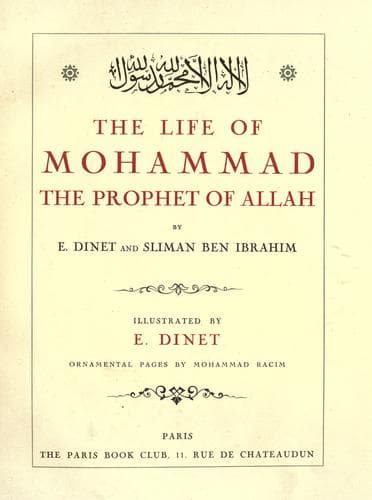
The Life of Mohammad, the Prophet of AllahDinet, Etienne
Religion
The Life of Mohammad, the Prophet of Allah
Dinet, Etienne
Muhammad, Prophet, -632
The Prophet's soldiers had got through the hardest part of their task.
They had triumphed over the obstacles opposed to them by Nature, and
henceforward could look with deep disdain on any barriers formed by
the weapons of the Infidels. Besides, thanks to the fantastic rapidity
with which tidings travel through the desert, their arrival at Tabuk
soon came to the ears of the Christians and the Syrian Arabs who had
formed a coalition to fight the Believers.
The enemies of Allah were overcome by stupor, for they had felt
certain that if the Prophet should try to carry out his audacious plan
at such a time of year, the bones of all the men of his army would be
scattered over the lonely Hijaz wilderness.
Therefore, in spite of their enormous numerical superiority, they
concluded that any struggle against forty thousand Believers who had
just accomplished this prodigious feat would be madness, and finish by
overwhelming their opponents with indescribable disaster. Strife broke
the ranks of their innumerable army, and each party it comprised fled
towards its own part of the country without having dared to face the
Prophet. The pitiful helter-skelter retreat of the allies enhanced the
magic power of Islam as greatly as the most brilliant victory; and if
Mohammad had not been kept back by the necessity of fulfilling his
mission in the Hijaz before any other undertaking, he could have
penetrated in the depth of the Palatinat almost without striking a
blow.
As it was, established at Tabuk, he received the eager submission of
the Arab lords who hurried to him, one and all, coming not only from
the vicinity, but also from distant regions, such as those of Sinai
and Syria. Alone, the proud Prince of "Dawmatu'l-Jandal," an important
town situated on the outskirts of the "Nefud" (Desert of Red Sand),
having refused submission, the Prophet sent Khalid the Terrible to
him; and he was brought to his knees at once.
During the few weeks' rest granted to his army, Mohammad never ceased
the work of organising the country and teaching new converts.
One event only saddened him in his success: the death of a most
devoted comrade, known as "Dhu Nijadayn," (the man with the two
shoulder-belts). To prove to all in what esteem he held this perfect
Mussulman, he insisted in helping, with his own noble hands, the
gravedigger to lower the body into the earth, and Ibn Mas'ud, jealous
at seeing the dead man so highly honoured, exclaimed: 'Ah! why am I
not buried in that tomb?'
[Sidenote: THE PROPHET GOES BACK TO AL-MADINAH]
The return journey took place without any incident worthy of
narration. The hot months having gone by, the army was spared the
pangs of thirst; and during the first days of the month of Ramadhan,
the soldiers re-entered Al-Madinah.
Public-domain text, read in full here on John Shaqi.
Reviews
Reviews
No reviews yet
Be the first to share your thoughts on this work.
Elsewhere in the archive
Join the Discussion
Join the discussion
Sign in to leave a comment or review.
Sign InorCreate an account