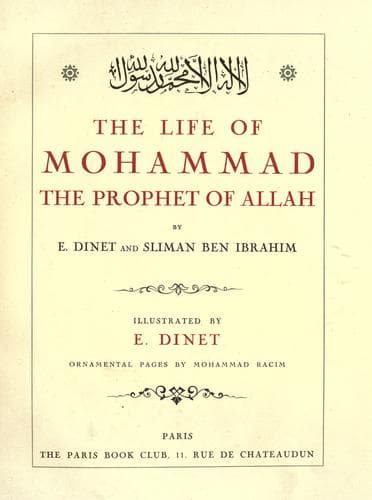
The Life of Mohammad, the Prophet of AllahDinet, Etienne
Religion
The Life of Mohammad, the Prophet of Allah
Dinet, Etienne
Muhammad, Prophet, -632
In such a moment, in the midst of the acclamations greeting the
returning, energetic soldiers, the perfidious "qawm" of the
"Hypocrites" knew not where to turn to hide their shame. To palliate
their meanness, they invoked the most specious pretexts in vain. The
Apostle did not even deign to honour them by resentment, reserved for
the shaming of the three Ansars, deterred from their duty by the
double-faced crew.
Despite the repentant humility of the abashed men, the Prophet
sentenced them most rigorously by putting them under interdict and
forbidding the Believers to have anything to do with them. The
delinquents were completely isolated and the Faithful fled from them
as if they were plague-stricken. Allah, notwithstanding, moved by
their remorse, pardoned them:
"_He hath also turned in Mercy unto the three who were left behind, so
that the earth, spacious as it is, became too strait for them; and
their souls became so straitened within them, that they bethought them
that there was no refuge from Allah but unto Himself. Then was he
turned to them that they might turn to him. Verily Allah is He that
turneth, the Merciful!_" (THE QUR'AN, IX, 119.)
The "Ghazwah" of Tabuk was the last expedition led by the Prophet. To
conclude the conquest of Arabia, he was satisfied thenceforth to send
his lieutenants to accomplish a certain number of "Saraya" or
expeditions, all fully successful, but which it would take too long to
describe here.
He dwelt in Al-Madinah, kept busy in receiving the numerous
submissions brought about by the victories of Islam. There were those
of the Princes of Dawmatu'l-Jandal; of the Yaman; of the Uman, of
Buhayra; of the Yamama; of Taif; of Najran, etc. He also devoted his
energies to the most difficult task of governing the Arabs, for the
first time united to form a people of brothers; and in his work as
legislator, he displayed the resources of as much genius as when he
was at the head of his armies.
About this time, the famous chief of the "Hypocrites," Abdullah ibn
Salul, died. Seized with remorse in his last moments, Abdullah
implored Mohammad's pardon and, despite the objections of ungovernable
Umar, the Prophet was not to be stopped from saying prayers over the
body of his perfidious foe and burying him with his own hands. After
this proof of clemency and forgetfulness of offences, there no longer
remained a single "Hypocrite" in Al-Madinah.
In his turn, Ka'b ibn Zuhayr, who had passed his life in composing
virulent satires against the Prophet, came to be converted by him, and
recited a poem which he had written in his honour. When Ka'b got as
far as the fifty-first verse:
"The Messenger of Allah is a flaming sword illuminating mortals; a
sword of India, unsheathed by Allah," Mohammad pardoned him, making
him a present of his mantle which he threw over the poet's shoulders.
Public-domain text, read in full here on John Shaqi.
Reviews
Reviews
No reviews yet
Be the first to share your thoughts on this work.
Elsewhere in the archive
Join the Discussion
Join the discussion
Sign in to leave a comment or review.
Sign InorCreate an account