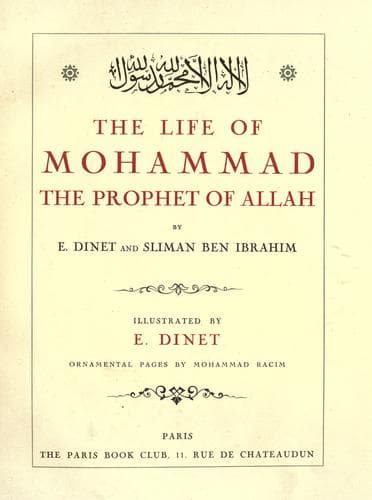
The Life of Mohammad, the Prophet of AllahDinet, Etienne
Religion
The Life of Mohammad, the Prophet of Allah
Dinet, Etienne
Muhammad, Prophet, -632
Abu Talib, much impressed by the warnings of a man whose scientific
reputation was universally recognised, made haste to finish his
business at Busra in Syria, and started back home to Makkah with his
nephew, where they arrived safe and sound.
Protected by Allah and guided by his uncle, who watched over him with
true paternal care, Mohammad grew up and became an accomplished young
man. He was extremely chaste. Abu Talib being busily engaged in
executing some repairs in the Zamzam well, several Quraish striplings,
among them being Mohammad, fetched and carried big stones fitted to
the work. So as to be more at their ease, they lifted up their _izars_
(a kind of tunic) in front, passing them over their head and rolling
them round the neck, thus protected from the sharp edges of the stones
carried on the shoulders; and all this was done without troubling
about the fact that they were showing their nakedness. Mohammad was
obliged to imitate them; but so soon as he felt his nakedness exposed
to every eye, he was seized with a fit of atrocious anguish; great
drops of sweat stood out on his brow; a shudder of shame shook his
entire frame and he fainted away.
Such innate modesty, and the protection granted by Allah to his Elect,
safeguarded the young man from the excesses in which lads often fall
at the period of puberty. Among all the youths of the same age, he was
the best-looking; the most generous; the most easygoing; the most
truth-telling; the most devoted friend; and the most devoid of
debauchery, to such an extent that his fellow-citizens called him
"Al-Amin," which means: "The Reliable Man."
[Sidenote: THE SECOND SYRIAN VOYAGE (_A.D. 594_)]
Like Abu Talib, most of the men of Makkah were obliged, to eke out a
living, to traffic with Syria and the Yaman.
Their town, situated in one of the most frightfully barren countries
of the world, offered no resources and its citizens only made both
ends meet by dint of trading with these two countries between which it
served as a link.
Its caravans crawled to the Yaman to procure raw materials from that
region, known as Arabia Felix; and also products brought from
overseas, imported from Ethiopia, India and even far China. The camels
came laden with fragrant spices, sweet-smelling incense, ivory, gold
dust, silks and many other articles of luxury. Arriving in the Hijaz,
they added dates from Yasrib or Taif. Then they wended their way into
Syria, to exchange these goods for agricultural produce, such as
grain, wheat, barley, rice, figs and raisins, as well as for imports
of Greek and Roman civilisation.
Even women carried on this kind of trade, confiding their goods to
those who organised caravans. These female traffickers sold the
merchandise in return for a share of the profits.
Public-domain text, read in full here on John Shaqi.
Reviews
Reviews
No reviews yet
Be the first to share your thoughts on this work.
Join the Discussion
Join the discussion
Sign in to leave a comment or review.
Sign InorCreate an account