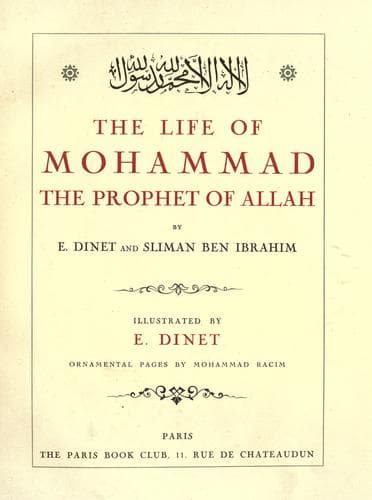
The Life of Mohammad, the Prophet of AllahDinet, Etienne
Religion
The Life of Mohammad, the Prophet of Allah
Dinet, Etienne
Muhammad, Prophet, -632
On arriving at the encampment of Al-Arj, the camel carrying the
provisions of the Prophet and of Abu Bakr was missing. Ayishah's
father laid the blame on the driver: 'How's this? Thou hadst but one
camel to look after and thou hast let it go astray?' Carried away by
great anger, Abu Bakr, with his whip, gave the man a good hiding.
'Admire the conduct of this pilgrim in the state of "Ihram!"' said the
Prophet, ironically. 'Come now, O Abu Bakr, be calm, and rest assured
that thy serving-man's sole desire was not to lose thy camel.'
The caravan took the same road as that of the pious visitation. The
Prophet entered Makkah in open day, and made his she-camel kneel in
front of the entrance of the Sacred Precincts, called the "Door of
Salvation," and on catching sight of the Ka'bah, he exclaimed: 'O
Allah, increase the glory of this Temple and the number of its
visitors!'
After three ablutions, he kissed the Black Stone, whilst tears welled
up in his eyes. He then performed the "Tawaf," and the "Sa'y," in the
same way as during the pious visit.
On the eighth day of the month of Zu'l-Hijjah, he went to the valley
of Mina where he caused a tent of woollen stuff to be pitched; and it
was there he said the prayers of the afternoon; of sunset; and of
nightfall. Next day, after the prayer of the "Fajr," he once more
bestrode his she-camel, al-Qaswa, in order to reach the mountain of
Arafa.
Countless crowds having gathered on the mountain's rocky slopes, as
well as on the plain and in the surrounding ravines, the Prophet
preached, remaining on his she-camel which he had ridden and halted on
the summit. Standing immediately beneath him, was Rabiyah ibn
Ummayatah, posted there to repeat the words of the sermon, with his
resounding voice, during a pause made for that purpose at the
conclusion of each sentence.
After Allah had been glorified by the "Takbir," the Prophet exhorted
the Faithful to treat their wives with the greatest gentleness, and
never to forget that the rights of spouses are equal to their duties.
He explicitly forbade the exaction of any interest whatsoever on money
lent; and no murders committed during the "days of ignorance" were to
be avenged. He fixed the duration of the year at twelve lunar months;
and declared that the "Nasi," which added a month every three years to
reestablish equilibrium and bring the same dates back to the same
seasons, was impious and must be abolished....
Public-domain text, read in full here on John Shaqi.
Reviews
Reviews
No reviews yet
Be the first to share your thoughts on this work.
Elsewhere in the archive
Join the Discussion
Join the discussion
Sign in to leave a comment or review.
Sign InorCreate an account