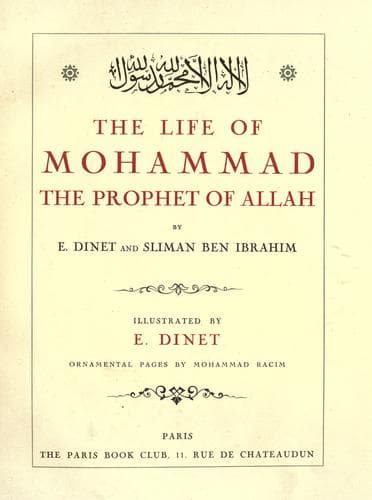
The Life of Mohammad, the Prophet of AllahDinet, Etienne
Religion
The Life of Mohammad, the Prophet of Allah
Dinet, Etienne
Muhammad, Prophet, -632
The following year, the Prophet determined to lead the pilgrimage to
Makkah personally. Since the Hegira, he had only accomplished the
"Amratu'l-Qada," or pious visitation, at a time when Makkah had not
yet been entirely won over to Islam. Now the "Hajj u'l-Akbar," or
Greater Pilgrimage, which imposes, besides the visit to the Sacred
Temple of Allah, a visit to the mountain of Arafa, or of Recognition,
(so called because our first parents, Adam and Eve, met each other
there after having been driven out of Paradise), is one of the five
pillars of the practical religion of Islam.
Mohammad also wished to see his native land for the last time, having
a presentiment of his coming end, for he felt himself secretly
undermined by the vestiges of poison remaining in his veins. He
solemnly announced his intention. The idea of seeing the Apostle of
Allah and accomplishing the pilgrimage with him, stirred the
enthusiasm of the whole of Arabia, and the number of pilgrims who
accompanied him from Al-Madinah or joined him on the way, may be set
down at about hundred thousand.
At Zu'l Hobfah, all the Faithful, following the Prophet's example, put
themselves in the state of "Ihram," as described in the chapter of
al-Hudaibiyah, and assumed the robe also called "Ihram," consisting of
two seamless wrappers free from any dye likely to stain the skin. One
piece of drapery is wrapped round the waist and the other, thrown
loosely over the shoulders, covers the chest; the head, arms, and legs
being left bare. After the Prophet had proclaimed the "Talbiyah," the
pilgrims took it up in chorus: "_I stand up for thy service, O Allah!
There is no Partner with Thee! Verily Thine is the Praise, the
Blessing and the Kingdom!_"
During the journey, two unimportant incidents arose which we note
nevertheless, because they show that a pilgrim is obliged to suppress
all feelings of impatience or anger. The camel of Safiyah, one of the
Prophet's wives, was a slow animal, and being heavily laden, did not
keep up with the caravan, despite the efforts of its driver. Ayishah's
camel, possessing a good turn of speed and lightly burdened, Mohammad,
after having tried to explain these facts to its fair rider, gave
orders to change the loads of the two animals. But this displeased
Ayishah. She lost her temper and cried out: 'Thou sayest thou art
Prophet? Then why not do things justly?'
No sooner had these words escaped her lips, than her father, Abu Bakr,
slapped her face; and as Mohammad upbraided him, he replied: 'Didst
hear what she said?'--'Yea; but she must be excused. The essence of a
woman's mind is jealousy; and when jealousy masters her, she is
incapable of seeing in what direction runs the current of a wadi!'
Public-domain text, read in full here on John Shaqi.
Reviews
Reviews
No reviews yet
Be the first to share your thoughts on this work.
Elsewhere in the archive
Join the Discussion
Join the discussion
Sign in to leave a comment or review.
Sign InorCreate an account