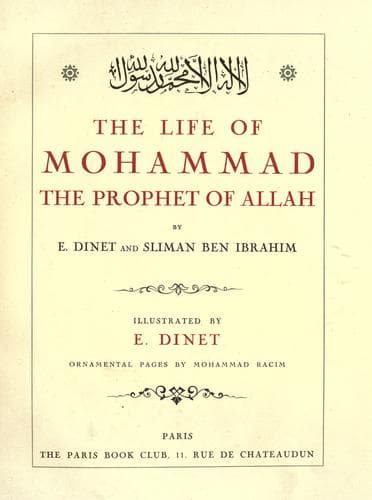
The Life of Mohammad, the Prophet of AllahDinet, Etienne
Religion
The Life of Mohammad, the Prophet of Allah
Dinet, Etienne
Muhammad, Prophet, -632
The Prophet gave the signal of departure; but to prevent the accidents
which any haste would inevitably cause among the great masses of such
a gathering, he tugged the bridle of swift Qaswa to him, twisting her
head round until her nostrils touched her ribs, whilst he slid on to
her withers; unceasingly exhorting all: 'Go quietly, O ye people!'
On arriving at Muzdalifa, he said the prayer, "Isha," and next day,
after the daybreak prayer, riding his she-camel, led by Bilal, and
protected from the sun by a mantle that Usama, riding behind him, held
over his head, he went into the valley of Mina, in order to throw
seven stones against each of the three pillars of rude masonry, called
"Jumurat." This is in commemoration of the pebbles thrown by Abraham
to drive away the Devil who thrice tried to stop him at that spot.
After that, the Prophet, to prove his gratitude for the sixty-three
years of life granted to him by the Creator, freed sixty-three slaves
and, with his own hands, sacrificed sixty-three camels, their flesh
and skins being distributed among the pilgrims by Ali, acting under
Mohammad's orders. He then had his head shaved by Mi'mar ibn Abdullah,
who commenced at the right temple and finished at the left. Finally,
after having once more performed the "Tawaf" round the Kab'ah, and
drunk for the last time some Zamzam water in a vase offered to him by
his uncle Abbas, the Superintendent of the Well, he set out again on
the road to Al-Madinah.
Such was the pilgrimage called the "Valedictory Visitation," which
overwhelmed the Believers with such deep emotion by apprising them
that Mohammad's Mission was fulfilled. This pilgrimage serves as a
pattern for all the pilgrimages which, during thirteen centuries, have
brought annually to these Holy Places, one hundred and fifty to two
hundred thousand pilgrims, collected from all parts of the universe.
Any pilgrimage, be the religion giving rise to it what it may, causes
inexpressible emotion by the sight of so many faces beaming with
faith; and the most sceptical among the onlookers finds it difficult
to escape the contagion of this outbreak of fervour. But, among the
majority of the spectators, inadmissible practices soon overcome
sympathetic feelings and change them into aversion. At Makkah,
doubtless, as in all religious centres without exception, pilgrims are
ruthlessly exploited; but in this city, at least, the traffickers may
be excused: they dwell in the most inhospitable of all deserts and
have no other means of getting a living.
Public-domain text, read in full here on John Shaqi.
Reviews
Reviews
No reviews yet
Be the first to share your thoughts on this work.
Elsewhere in the archive
Join the Discussion
Join the discussion
Sign in to leave a comment or review.
Sign InorCreate an account