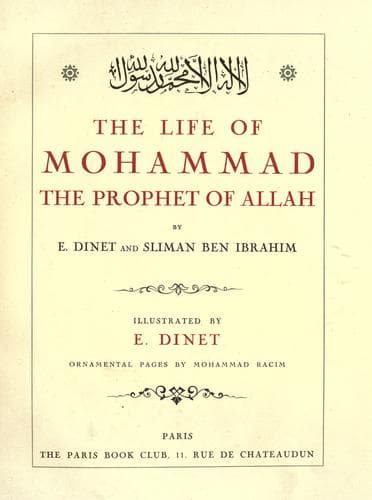
The Life of Mohammad, the Prophet of AllahDinet, Etienne
Religion
The Life of Mohammad, the Prophet of Allah
Dinet, Etienne
Muhammad, Prophet, -632
What makes the Mussulman pilgrimage essentially different to any
other, is the absence of those innumerable chapels, whose narrow
arches imprison souls, hampering them as they soar towards the Creator
and holding them back on earth at the mercy of the clergy. Here are no
fetishes, such as statuettes or miraculous icons, surrounded by their
procession of votive offerings; nor that multitude of saints, their
worship taking the place of that of the "Eternal," generally neglected
on these occasions. There are also none of those monks clad in varied
gowns, all jealous of each other; quarrelling over pilgrims and
religious resorts for the greater glory of their sect or order.
At Makkah, prayers are said in the vast quadrangular courtyard
surrounding the Ka'bah; the ethereal vault of heaven takes the place
of the masonry work of chapel roofs and, purified from all its mists,
it opens to souls thirsting for ideal good, its lapis-lazuli depths,
more vertiginous here than in any other part of the world. At Makkah,
nothing is worshipped except Allah, the Chosen One, and pilgrims seek
the remembrance of Abraham and Mohammad for no other reason than to
strengthen the fervour of their faith by following the Prophet's
example. They never pray to these Prophets in the same way as
Christians adore their saints; on the contrary, Moslems pray to Allah
for their prophets.
The gates of the Ka'bah enclosure are open day and night. The pilgrim
hurries there as soon as he gets to Makkah. At the sight of the temple
draped in black, the object of his unceasing thoughts during the
severe ordeals of the journey, in the midst of sandstorms or
tempest-tossed, he is overtaken by such emotion that in this moment of
superhuman ecstasy, he wishes his soul to be snatched away. Sobbing,
his breast heaving fitfully, under the influence of remorse, his face
convulsed by shame, he approaches the Black Stone to kiss it,
exclaiming: 'O Allah! pardon me my sins; free my being from their
burden and purify my heart, O Thou, the most Merciful among the
Compassionate!'
When the hour of prayer is called by the Muazzin, the spacious
quadrangle is invaded by a veritable sea of Believers; their hurrying
waves scarcely leaving in the serried ranks the needful space for
prostration. Following one of the "Takbirs" of the Imam, said after
him in an immense sigh escaping simultaneously from every breast, a
great swell passes over all the Faithful, causing every head to be
bowed, like billows breaking.
Public-domain text, read in full here on John Shaqi.
Reviews
Reviews
No reviews yet
Be the first to share your thoughts on this work.
Elsewhere in the archive
Join the Discussion
Join the discussion
Sign in to leave a comment or review.
Sign InorCreate an account