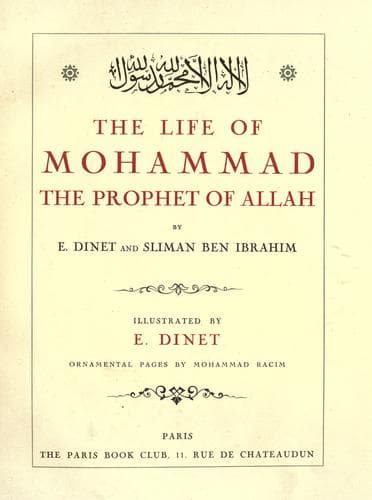
The Life of Mohammad, the Prophet of AllahDinet, Etienne
Religion
The Life of Mohammad, the Prophet of Allah
Dinet, Etienne
Muhammad, Prophet, -632
At another "Takbir," it seems that the ground suddenly gives way under
the pilgrims' feet. At one bound, every forehead is pressed to the
earth, where the body of each man remains crushed by the threefold
weight of Contrition, Gratitude and Adoration; like so many rays
converging in the direction of the Temple which seems to be made still
taller by the added height of the prostrated pilgrims. Above them, the
black silk veil undulates, stirred by the gusts of a mysterious breeze
which many attribute to angels' beating wings.
The Assembly of the Arafa is distinguished by quite as much grandeur.
In a wild valley stands the conical mountain of Arafa. Its slopes,
bare of all vegetation, bristle with enormous boulders. There is no
sign of life on its sides, nor in the neighbourhood; all around is the
image of desolation and the silence of death. But every year, on the
ninth day of the month of Zu'l-Hijjah, the funereal landscape evokes
most strikingly the future Day of Resurrection.
Soil, sand and rocks disappear, truly cloaked by human beings,
enwrapped in their white "ihrams," and who might be taken for the
resuscitated dead, freeing themselves from their shrouds after having
lifted the rocks which were their gravestones. As it will happen on
that supreme day, all the earth's races are represented in the
countless crowds gathered together at this spot, deserted but a short
time before. Here some Arabs, with eyes of eagles, their complexion of
a reddish bronze; Ottomans, their features showing them to be
energetic and headstrong; Hindoos, with faces clear-cut and
olive-tinted; Berbers, fair-haired and rosy-cheeked, their eyes blue;
Somalis and Soudanese, their black skins shining in the sun with lunar
gleams; refined Persians; bold Turcomans; yellow Chinese, with closed
eyelids; Javanese, high cheek-boned, etc.... Nowhere else in the world
can such a variety of faces and languages be met with.
After the prayer of the "Asr," (afternoon), the "Khatib," or preacher,
riding his she-camel, gorgeously harnessed, appears on the summit of
the Arafa where the sermon is given forth, interrupted by frequent
"Talbiyahs": "_Labbaika! Allahummah! Labbaika!_" (I stand up for Thy
service, O Allah! I stand up! I stand up!)
At each "Talbiyah," the pilgrims wave the ends of their white
draperies over their heads and the whole mountain seems to be
palpitating under the beating of myriads of wings ready to fly, whilst
a lengthy clamour rises to the sky from every part of the valley,
reverberating in the sonorous echoes of the desert. "_Labbaika!
Allahummah! Labbaika!_" shout two hundred thousand pilgrims with one
voice, neglecting their own idioms, so as to become united in the same
tongue: that of the Arabs, chosen by the Almighty for the Revelation
of His Book.
Public-domain text, read in full here on John Shaqi.
Reviews
Reviews
No reviews yet
Be the first to share your thoughts on this work.
Elsewhere in the archive
Join the Discussion
Join the discussion
Sign in to leave a comment or review.
Sign InorCreate an account