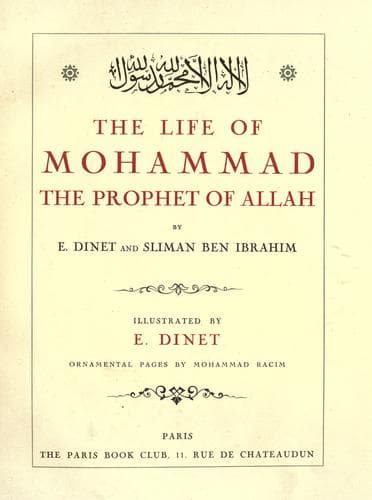
The Life of Mohammad, the Prophet of AllahDinet, Etienne
Religion
The Life of Mohammad, the Prophet of Allah
Dinet, Etienne
Muhammad, Prophet, -632
If feelings of kindly dignity prevented Mohammad from resorting to
vulgar mockery or making use of cutting remarks, his mood was
nevertheless playful. He was fond of joking, which is not reproved by
Allah, if the sally contains a grain of truth. One day, for amusement,
he told Safiyah, his aunt on his father's side, that 'old women were
not allowed to enter Paradise.' The noble dame, well advanced in
years, burst into tears. So he went on: 'But all women will be
resuscitated with the aspect of females thirty-three years of age,
just as if they had all been born on the same day.'
The three things he loved best in this world were prayer, perfumes,
and women.
He was so fond of praying that his feet used to swell in consequence
of standing for too long a time whilst at his devotions; but he
considered that the right to pray so often was one of the prerogatives
of his position as a Prophet. Still he would not admit that his
example should be followed. This he proved when upraiding Abdullah ibn
Amir: 'Have I heard aright when they tell me thou dost pass the night
in prayer, upstanding; and then fast next day? If thou shouldst keep
on at this, thou wilt endanger thy sight and wear out thy body. Thy
duty, that thou owest to thyself and thy people, is to fast and break
thy fast; to rise in the night and also to sleep.'
Next to prayer, Mohammad preferred women, for which his detractors
have blamed him severely. He was certainly an ardent lover; a male, in
every respect, morally and physically, but endowed with that chastity
which fits in well with healthy voluptuousness. Following his example,
even nowadays, the Arabs are remarkable for their extreme decency,
although devoid of all affectation and having nothing in common with
the hypocritical mock-modesty of Puritans.
Mohammad had twenty-three wives, but he only had intercourse with
twelve of them; his other marriages taking place for political
reasons. All the tribes were eager to be allied to him through one of
their daughters and he was beseiged by matrimonial offers. One of
these women, Azza, sister to Dihya al-Kalbi, died of joy when she
heard that the Prophet accepted her as spouse.
His love of women caused him to be brimful of kindness to them,
and he sought to better their lot whenever he could. To begin
with, he abolished the monstrous custom of burying girls alive,
"Wa'du'l-Binat," of which we have already spoken. He then regulated
polygamy, limiting the number of legitimate helpmates to four, which
did not prevent him from urging the Faithful to give heed to this
verse of the Qur'an: "_If ye fear that ye shall not act equitably,
then marry but one woman only._" (IV, 3.)
Then, after declaring that: 'among all things which are licit, divorce
is the most displeasing to Allah,' he allowed a wife to ask for
release if the husband neglected the duties of marriage.
Public-domain text, read in full here on John Shaqi.
Reviews
Reviews
No reviews yet
Be the first to share your thoughts on this work.
Elsewhere in the archive
Join the Discussion
Join the discussion
Sign in to leave a comment or review.
Sign InorCreate an account