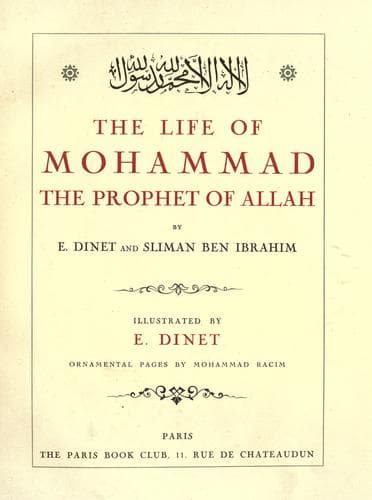
The Life of Mohammad, the Prophet of AllahDinet, Etienne
Religion
The Life of Mohammad, the Prophet of Allah
Dinet, Etienne
Muhammad, Prophet, -632
Finally, thanks to his ruling, a virgin could no longer be taken in
marriage against her will; the dower, formerly given by the husband to
the father of the affianced maiden, was ordered to be handed over to
her. Such is the wise custom of the dower which the enemies of Islam
call the purchase of a wife. Doubtless, they know nothing about the
terrible retort of Moslems when they notice that in certain Western
countries the dowry is paid to the bridegroom by the bride's father!
Over and above the dower, the Mussulman husband has to defray
household expenses without touching his wife's fortune to which he has
no right.
The Prophet also ordained that a wife is always entitled to some part
of an inheritance. If it is only half a share, that is because the
compensation found by the spouse in the dowry and the household upkeep
is taken into account.
The Prophet was fond of perfumes; for they completed the process of
purification by ablutions. The man who has a sweet smell will be
worthier and better able to safeguard his honour than he whose bodily
odour is disgusting. Mohammad scented himself with musk and he liked
sandal-wood, camphor and ambergris to be burnt. He used pomade for his
hair, and four plaits hung down over his ears, two on each side. He
clipped beard and moustache with scissors, keeping all in order by
means of an ivory, or tortoise-shell comb. He blackened his eyelids
with "Kuhl," which brightens the eye and strengthens the lashes. He
took care of his teeth by rubbing them often with the "Miswak,"
(fragment of soft "Araq" wood), of which the fibre, when the end is
chewed, has the same effect as a brush.
His apparel consisted generally of a tunic of cotton cloth,
short-sleeved, and not too long; together with a cloak, four cubits
long and two wide, woven in the Uman region. He also had a Yamanite
mantle, six cubits long and three wide, which he wore on Fridays and
holydays. Then, last of all, came his green mantle, inherited by the
Caliphs; and a turban known as "As-Sahab," bequeathed to his
son-in-law, Ali.
The Prophet took the greatest care of his personal appearance and
reached as far as simple, although very refined elegance. He was wont
to look at himself in a mirror, or if that was lacking, in a jar full
of water, to comb his hair, or adjust the folds of his turban, letting
one end hang down behind his back. He used to say: 'By attending to
our exterior, we please Him of whom we are the servants.'
To make amends, he severely condemned extravagance in clothing;
particularly the use of silk, which for rich people furnishes an
opportunity for a display of pride belittling the needy; but he
permitted it for those to whom it was necessary for reasons of bodily
health.
Public-domain text, read in full here on John Shaqi.
Reviews
Reviews
No reviews yet
Be the first to share your thoughts on this work.
Elsewhere in the archive
Join the Discussion
Join the discussion
Sign in to leave a comment or review.
Sign InorCreate an account