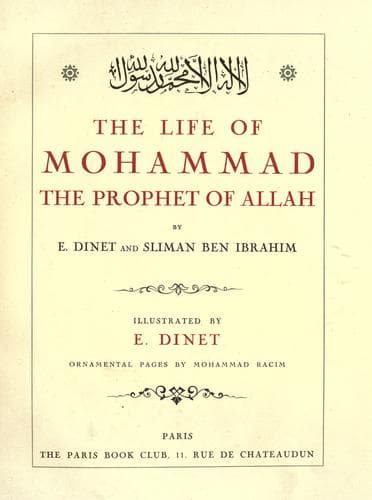
The Life of Mohammad, the Prophet of AllahDinet, Etienne
Religion
The Life of Mohammad, the Prophet of Allah
Dinet, Etienne
Muhammad, Prophet, -632
This marvellous épopée engrossed the mind of the most wonderful man of
our time, Napoleon, who always manifested the most sympathetic
interest in favour of Islam. During the Egyptian campaign, he declared
that he was: "Muslimun Muwahhidun," _i.e._ Unitarian Mussulman.
(_Bonaparte el l'Islam_, by Ch. Cherfils.) Towards the end of his
life, he returned to the subject: 'He thought that apart from
fortuitous circumstances, giving rise to miracles, there must have
been something more than we know in the establishing of Islam; that
the Christian world had been so remarkably cut into by the results of
some first cause still hidden; that these peoples, perhaps, suddenly
emerging from the desert depths, had endured long periods of civil war
in their midst, during which great characters and talents had been
formed, as well as irresistible impulses, or some other cause of the
same kind.' (Las Casas, _Mémorial de Sainte-Hélène_, iii, p. 183.)
Guessing, therefore, that beneath the slumber of Islam in decadence,
there were incomparable reserves of energy, he tried, not once but
often, to win it over by an alliance. If he succeeded, he deemed
himself capable of awakening it and, by its aid, changing the face of
the world.
Napoleon was not mistaken; civil wars had indeed exalted the heroic
qualities of the Arabs, but they had made all organisation and
progress impossible. Had it not been for the advent of Mohammad, these
intrepid soldiers would have remained eternally in their deserts,
solely absorbed by the obsession of hereditary feuds.
When Islam, abolishing pride of caste, birth, or race, made all
Believers really brothers and endowed them with religious and poetical
souls, based on equality, there was no exploit that these fiery-minded
men, their hearts untamable, were incapable of performing. These
treasures of combative energy, accumulated during centuries of civil
war, were not the only means by which they overthrew so many peoples,
all different and superior to them in culture at that epoch. The
Arabs, likewise, had stored dream-treasures in their deserts, and
these visions of an unpolished, though young people were about to be
imposed on those peoples who, although educated, were old and
worn-out.
We advise all those who may have doubts about the genius of the Arabs
to look through a collection of photographs showing the edifices
erected in every part of the countries they held in subjection. There
is nothing more striking than the unity of type distinguishing these
monuments from all other monuments in the world; and these buildings,
with their remarkable family likeness, were set up in India,
Turkestan, Persia, Syria, Turkey, Egypt, Barbary, Spain, etc., all
countries essentially different and so peculiar, by reason of their
characteristic genius, that the genius of Greece or Rome was never
able to be grafted successfully.
Public-domain text, read in full here on John Shaqi.
Reviews
Reviews
No reviews yet
Be the first to share your thoughts on this work.
Elsewhere in the archive
Join the Discussion
Join the discussion
Sign in to leave a comment or review.
Sign InorCreate an account