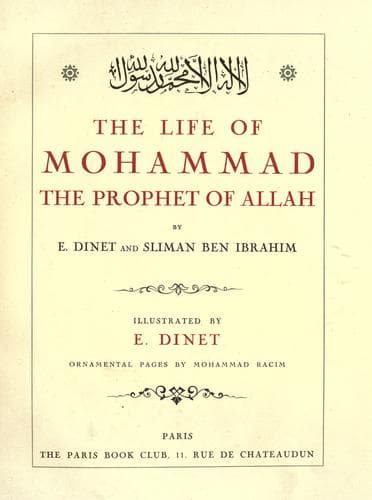
The Life of Mohammad, the Prophet of AllahDinet, Etienne
Religion
The Life of Mohammad, the Prophet of Allah
Dinet, Etienne
Muhammad, Prophet, -632
The Arabs borrowed largely from those they conquered, often utilising
their talent and even their muscles in order to build palaces and
mosques; but Arabic dreams were thus always realised.
The exceptional originality of the Arab style resided in the fact that
it was always imperiously guided by an art that was born at the same
time as Islam. This art had no predecessors and offers us, as it were,
the materialness of the Arabs' ideal. It is the art of calligraphic
decoration, applied to the glorification of the word of Allah,
otherwise the verses of the Qur'an.
Even reduced to its own resources, this art of Arabic calligraphy is
one of the most marvellous forms of decorative skill that has ever
sprung from human imagination. It is perhaps the only science of
ornament of which it may be said without exaggeration that it
possesses a soul, for like the voice, it expresses thought. Owing
nothing even to the most cultured parts of the outer world, its
independence resembles that of music and seems like the stenography of
the innermost beatings of the heart.
Look at the letters which spring swiftly and horizontally from right
to left as if acting under the impulse of inward life. Then they whirl
on their own axis in discreet or impassioned curves, and are next
erect, coming to a sudden halt, fixed in perpendicular pride.... They
soon start off again in their frenzied gallop, unrolling their
flourishes, bestriding each other in delicious fantasy and causing the
imagination to soar in wild dreams.
To follow the impulses of the reed-pen having traced these letters;
and in order to enjoy the pure eminence of their form or the intense
emotion of their curve, one need not be a past master of Arabic, or a
subtile graphologist; any artistic mind can penetrate without any
effort the secrets of their soul.
After having expressed the ideal of his nation with such
perfection, the Arab calligrapher bent beneath his yoke--almost
religious--everything that was destined to support or enframe it:
architecture and other systems of embellishment, forcing them to yield
to the sway of his shaping skill. Under this yoke, the heavy,
hemispherical dome of Byzantium was improved by adopting the pure
outline of the Saracen helmet. The curves of the commonplace arcade
became those of the graceful ogive, or of the proud, far-extending
arch. The vulgar towers were metamorphosed into elegant minarets,
leaping towards the peaks of ecstasy.
[Illustration: _Theological Students, in the Courtyard of Al-Azhar,
the great Cairo Moslem University._]
Public-domain text, read in full here on John Shaqi.
Reviews
Reviews
No reviews yet
Be the first to share your thoughts on this work.
Elsewhere in the archive
Join the Discussion
Join the discussion
Sign in to leave a comment or review.
Sign InorCreate an account