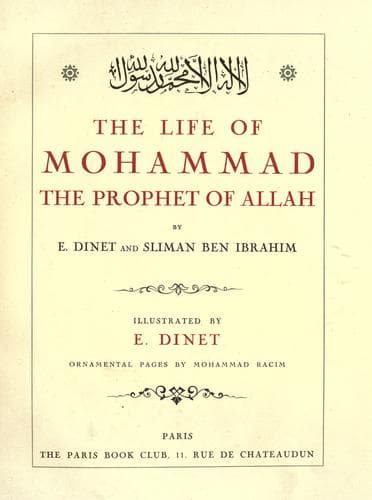
The Life of Mohammad, the Prophet of AllahDinet, Etienne
Religion
The Life of Mohammad, the Prophet of Allah
Dinet, Etienne
Muhammad, Prophet, -632
"After having established that the highest degree of science consists
in giving rise to phenomena oneself and at will, the celebrated
scientist Humboldt adds: "The Arabs reached to this height, which was
almost unknown to the ancients."
"The study of mathematics enjoyed overspread favour among the Arabs,
and the progress accomplished in algebra metamorphosed that science to
such an extent that its invention has been attributed to them. To them
also are due the first application of algebra to geometry, and the
introduction of tangents into trigonometry.
"Astronomy was passionately studied in their schools of Bagdad,
Damascus, Samarcand, Cairo, Fez, Toledo, Cordova, etc., and their
discoveries may be summed up in the following enumeration:
introduction of tangents into astronomical calculation; construction
of tables of planetary movement; strict determination of the obliquity
of the ecliptic and of its gradual diminution; exact estimation of
the procession of the equinoxes; and the first precise determination
of the year's duration. To them also we owe the ascertainment of the
irregularities of the greatest latitude of the moon, and the discovery
of the third lunar inequality, now called variation.
"In geography, the contribution of these bold travellers is most
remarkable from a scientific viewpoint. They made those exact
astronomical determinations which form the first foundation of
cartography, and rectified the enormous errors of position committed
by the Greeks.
"From the standpoint of exploration, they published accounts of travel
which caused different parts of the world, scarcely suspected before
them, to be known, and where no European had ever set foot. The
sources of the Nile, running through the great equatorial lakes, are
exactly set out on a map by Al-Idrisi, dating from the year 1160, and
which were only discovered by Europeans during the second half of the
nineteenth century.
"In physical sciences, the sum total of their discoveries is still
more considerable. The following enumeration proves their importance:
high attainment of knowledge in theoretical physics, especially in
optics and in the creation of the most ingenious mechanical apparatus;
discovery of the most fundamental bodies of chemistry, such as
alcohol, nitric acid, sulphuric acid; and the most essential
operation, such as distillation; application of chemistry to pharmacy
and commerce, especially as regards the extraction of metals, the
manufacturing of paper from rags, which they caused to take the place
of parchment, papyrus, or Chinese silk-paper.
"They were probably the first to use the compass in navigation; at any
rate, they certainly introduced this fundamental invention to Europe.
Public-domain text, read in full here on John Shaqi.
Reviews
Reviews
No reviews yet
Be the first to share your thoughts on this work.
Elsewhere in the archive
Join the Discussion
Join the discussion
Sign in to leave a comment or review.
Sign InorCreate an account